February 6, 2026
How to Use AI for SEO and Actually Boost Your Rankings
Using AI in your SEO isn't just about automating a few tasks. It's about weaving artificial intelligence into the very fabric of your workflow, from initial keyword research and content creation all t...
Table of content
February 6, 2026
Using AI in your SEO isn't just about automating a few tasks. It's about weaving artificial intelligence into the very fabric of your workflow, from initial keyword research and content creation all the way to technical optimization and performance analysis. This integrated approach is essential for moving faster, uncovering deeper insights, and staying relevant as search engines and AI assistants like ChatGPT and Perplexity evolve.
Why Your Old SEO Playbook Is Obsolete
Let's be blunt: the SEO game has fundamentally changed. This isn't just another passing tech trend. It’s a seismic shift in how people find information. Sticking to old-school keyword strategies and link-building tactics is like trying to navigate a new city with a tattered paper map—sure, you might eventually get there, but you’ll completely miss the faster, smarter routes everyone else is already on.
Generative engines like Gemini, Perplexity, and Google’s AI Overviews are completely rewriting the user discovery rulebook. They don't just serve up a list of blue links anymore. They synthesize information from multiple sources to give people direct answers. This reality forces us to move beyond simply chasing keyword rankings.
From SEO to AEO
The new mandate is to become a trusted, definitive source of information. This is the heart of Answer Engine Optimization (AEO)—the practice of positioning your brand as the go-to authority that AI engines rely on and cite. When someone asks a question, the goal is for the AI to point to your brand, your data, or your product as the answer. This requires building real topical authority and entity recognition, which we'll get into throughout this guide.
The core challenge has shifted from "How do I rank for this keyword?" to "How do I become the trusted entity behind the answer?" This distinction is critical for long-term visibility and success.
To really make AI work for your SEO, you have to bake it into every single stage of the process, from high-level planning down to the nitty-gritty execution.
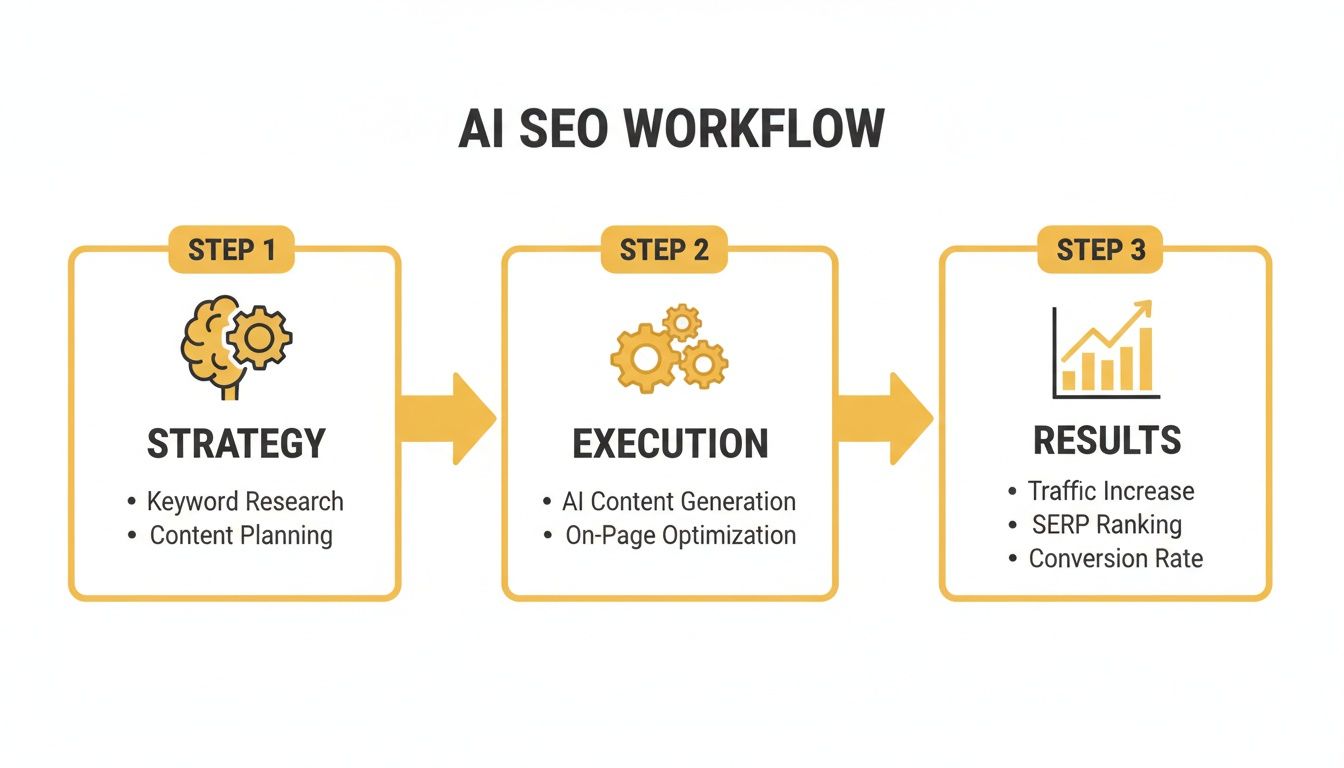
This diagram shows that AI isn't just another content tool; it's a strategic layer that enhances your entire optimization lifecycle. The data is already backing this up. Companies that have embraced AI-driven strategies have reported up to a 45% increase in organic traffic. This is huge, especially when you consider that the number of US adults using AI for search is expected to jump from 13 million to 90 million by 2027.
With 86% of SEO professionals already using AI, standing still is the same as falling behind.
How AI Transforms Your SEO Workflow
Let's look at a quick comparison of traditional SEO tasks versus their modern, AI-enhanced counterparts. The difference is in speed, depth, and scale.
SEO Pillar | Traditional Approach | AI-Enhanced Approach | Strategic Impact |
|---|---|---|---|
Keyword Research | Manual analysis of high-volume keywords in tools like Ahrefs or Semrush. | AI-driven topic clustering, long-tail opportunity identification, and predictive trend analysis. | Uncovers hidden, high-intent queries and builds topical authority faster by mapping entire user journeys. |
Content Creation | Writing based on a keyword list, competitor analysis, and manual outlines. | Generating comprehensive, entity-rich briefs, drafting content, and optimizing for semantic relevance in real-time. | Produces higher-quality content at scale, covering topics more thoroughly and answering user questions directly. |
On-Page SEO | Manually writing title tags, meta descriptions, and alt text based on best practices. | AI-generated, CTR-optimized titles/metas, schema markup creation, and internal link suggestions. | Saves hours of manual work, improves SERP click-through rates, and provides clear context to AI crawlers. |
Technical SEO | Periodic manual site audits, log file analysis, and fixing crawl errors. | Proactive monitoring of site health, automated identification of crawl budget issues, and code optimization suggestions. | Catches critical technical issues before they impact rankings and ensures a smooth crawling experience for all bots. |
This table just scratches the surface. AI introduces a level of efficiency and strategic depth that was simply out of reach before.
Of course, knowing how to measure success in this new landscape is just as important as the execution itself. For a deeper dive into the new metrics that matter, check out our guide on achieving AI visibility for SaaS platforms. For now, let's focus on the high-level roadmap and practical steps you can take to navigate this new terrain.
Building Your AI-Powered Content Strategy
A winning SEO strategy doesn't start with an endless spreadsheet of keywords anymore. Before a single word gets written, you need a smarter plan—one that’s built on a rock-solid understanding of what your audience actually needs. This is the perfect place to put AI to work, not just as a writer, but as your master strategist.
The whole point is to shift from chasing individual keywords to truly owning entire topics. AI is brilliant at this. It can perform sophisticated topic clustering, pulling together all the related queries and concepts into neat, logical groups. This process helps you see the forest for the trees, revealing the much bigger conversations your audience is already having.
Uncovering Hidden User Intent with AI
Your customers are constantly telling you what they want, just not always on your website. They're leaving reviews, asking questions on Reddit, and airing grievances on forums. Trying to sift through all that manually is a herculean task. AI, on the other hand, can analyze thousands of these unstructured comments in minutes to pinpoint exactly what users are looking for but aren't finding.
Let’s walk through a real-world scenario.
Imagine an e-commerce brand that sells high-performance running shoes. They want to create content that’s genuinely useful. Instead of just targeting a generic term like "best running shoes," they use an AI tool to analyze 500 product reviews from their top three competitors, plus all the relevant discussions in the r/running subreddit.
The AI quickly surfaces some recurring themes:
A ton of customers complain about blisters on long runs and are desperately seeking shoe recommendations to prevent them.
Many new runners are totally confused by terms like "heel drop" and "pronation." They're asking for simple, jargon-free explanations.
There's a surprising amount of chatter around "marathon training shoe rotation," a more advanced concept the brand hadn’t even considered covering.
These insights are pure gold. They represent real problems from qualified buyers—the kind of specific topics your competitors, still stuck on broad keywords, are probably missing entirely. This turns your content plan from a guessing game into a data-driven response to actual customer pain points.
Creating Strategic Content Briefs
Once you've nailed down these strategic content pillars, the next move is to build out detailed briefs to guide the actual writing. An AI-assisted brief is so much more than a primary keyword and a word count; it's a complete blueprint for creating content that nails it for both human readers and search engine crawlers.
A great content brief is the bridge between your strategy and the final published piece. Using AI to build it ensures your content is perfectly aligned with user intent and semantic search from the get-go.
A really solid AI-powered brief should always include:
Target Audience & Core Problem: Get specific. Who is this for? What exact pain point, discovered in your research, does it solve?
Key Entities & Concepts: List out the non-negotiable people, places, and ideas that must be included to show you know your stuff. For our running shoe example, this would include "blister prevention," "moisture-wicking socks," "heel-to-toe drop," and "gait analysis."
Question-Based Outline: Don't just list topics. Structure the content around the actual questions people are asking. Use AI to pull a list of "People Also Ask" (PAA) queries and related questions from those forums you analyzed.
Internal Linking Targets: Pinpoint existing pages on your site that you can link out to. This strengthens your topic cluster and keeps users clicking around your site longer.
This level of detail makes every piece of content purposeful. For particularly deep or complex topics, this process can touch on some serious information architecture. In those cases, looking into specialized technical writing services can give you the expert guidance needed to structure everything clearly for both your audience and the search bots.
By front-loading your strategic work with AI, you make sure your content creation efforts are focused, efficient, and far more likely to get the visibility you're after.
Creating and Optimizing Content With AI
With your AI-powered strategy locked in, it's time to get your hands dirty. This is where AI stops being the strategist and becomes your creative partner, helping you build and polish content at a scale that just wasn't possible before. The goal isn't just to be fast; it's to create content that’s genuinely helpful and comprehensive—something that clicks with real people while being perfectly tuned for search engines.
But let's be clear: this whole process is a partnership between machine efficiency and human expertise. If you treat AI like a vending machine that just spits out finished articles, you're going to end up with generic, bland content that goes nowhere. Instead, think of it as the world's most capable research assistant and first-draft writer. It sets the stage, and you deliver the masterful performance.

Crafting Prompts for High-Quality First Drafts
The old saying "garbage in, garbage out" has never been more true. Vague prompts get you vague, useless content. To get great results, you have to be specific, give the AI some context, and tell it exactly what role to play.
Let's walk through a real-world example. Say we're writing a blog post on "blister prevention for runners," based on the pain points we uncovered earlier. Here’s how you get a genuinely useful outline and intro.
Prompt Example: Generating an Article Outline "Act as an expert running coach and physical therapist. I'm writing a comprehensive blog post for beginner to intermediate runners who are fed up with blisters. They need practical, actionable advice they can use today. Using the core user intents of 'preventing foot blisters,' 'choosing the right socks,' and 'understanding shoe fit,' generate a detailed article outline. Use H2s and H3s. Make sure to include a section that debunks common blister myths. The tone should be encouraging and knowledgeable but easy to follow—no complex medical jargon."
This prompt is effective because it assigns a persona (expert coach), defines the audience and their mindset (frustrated runners), specifies the topics, and sets the tone. You're essentially giving the AI guardrails, which helps it generate a structured, relevant, and genuinely helpful starting point.
Finding the Gaps Your Competitors Missed
Here's where using AI for content creation gets really interesting: competitive gap analysis. AI can tear through the top-ranking articles on any topic and pinpoint what they all missed.
Imagine you're trying to rank for "best home coffee maker." You can feed the top three competing URLs into an AI tool and ask something like this:
"Analyze these three articles. What are the key topics, features, and questions they all cover about home coffee makers? Now, find me at least five relevant sub-topics or customer questions that none of them answer in detail. Think about things like cleaning and maintenance, long-term durability, or the environmental impact of coffee pods."
In minutes, the AI will hand you a list of opportunities. Maybe none of your competitors talk about how water filtration affects coffee quality, or the actual cost-per-cup difference between a drip machine and an espresso maker. These gaps are your golden ticket to creating the most thorough resource on the page.
The Human-in-the-Loop Workflow
I'll say it again: AI-generated text is a first draft. It's never the final product. A "human-in-the-loop" (HITL) process is absolutely essential to ensure your content is accurate, high-quality, and sounds like your brand. It’s how you add your unique perspective and prove you know your stuff.
AI brings the scale, but human expertise brings the soul. The best workflow uses AI for 80% of the heavy lifting, reserving that critical 20% for human insight, fact-checking, and storytelling that no machine can replicate.
Here's a simple checklist to run through for every piece of AI-assisted content:
Fact-Check Everything. AI models can "hallucinate" and state things with complete confidence that are flat-out wrong. Verify every statistic, date, and claim. Is that data from 2015? Is that product feature still available?
Inject Your Unique Voice. Does this sound like you? Go through and edit the text to match your brand's tone. Add a personal story, a unique case study, or some proprietary data that only you have.
Add E-E-A-T Signals. Weave in clear signals of Experience, Expertise, Authoritativeness, and Trustworthiness. Get a quote from a subject-matter expert on your team. Link out to original research you've published. Add author bios with real credentials. This is something AI simply can't fake.
Optimize for Readability. Chop up those long sentences and dense paragraphs. Use bullet points, bold text, and blockquotes to make the content easy to scan. Make sure the ideas flow logically from one point to the next.
This hands-on editing process is what separates valuable, AI-assisted content from the sea of robotic articles flooding the web. If it sounds like a lot, partnering with a team that has this down to a science can make all the difference. You can see how experts blend AI efficiency with human oversight in our overview of modern SEO services. By making this process a habit, you can turn AI into a content engine that creates high-quality, authoritative work that both people and search engines will value.
Getting Technical: Building a Foundation for AI and Search
Look, creating fantastic content is a huge part of the game, but it's only half the battle. If search engines—both the traditional ones and the new AI-powered answer engines—can't crawl, understand, and categorize your site, your best work might as well be invisible. This is where technical SEO comes in. It’s the essential bridge between your content and the algorithms that decide who sees it.
When we talk about using AI for SEO, this isn’t just about ticking boxes for Googlebot. It's about feeding Large Language Models (LLMs) the clean, structured, and unambiguous information they crave to trust your brand enough to recommend it.
Think of your website like a massive library. Your content is all the amazing books on the shelves. Technical SEO? That’s the librarian, the card catalog, and the logical layout of the building itself. Without it, you have a chaotic mess where no one, human or bot, can find a thing. The good news is that AI tools are making it easier than ever to get your library in perfect order.
Using AI to Nail Your Structured Data
If there's one technical element you absolutely must get right for Answer Engine Optimization (AEO), it's structured data, usually implemented with Schema markup. It's basically a special vocabulary that you add to your site's code to explicitly tell search engines what your content is about. No more guesswork. For an LLM that needs hard facts, this is gold.
In the past, writing the JSON-LD code for Schema was a real headache. It was tedious, prone to syntax errors, and usually required a developer's time. Now, you can get AI to generate the code for you in seconds with a simple prompt.
Let’s say you’re an e-commerce company. Here’s how you’d handle a product page:
Example Prompt to Generate Product Schema "Act as a technical SEO expert. I need you to generate the full JSON-LD Schema markup for a 'Product' page.
Here are the details:
Product Name: 'Aero-Fast Running Shoe'
Price: $135
Customer Rating: 4.8 out of 5
Review Count: 250
Availability: In Stock
Brand: 'Velocity Gear'
Make sure the code is complete, validated, and ready to be pasted into my site."
This prompt feeds the AI all the key entities—product name, price, rating, and so on. It spits out a clean block of JSON-LD code. All you have to do is copy it, paste it into the <head> section of your page, and run it through a tool like Google's Rich Results Test to double-check. What used to be a technical chore is now just a quick conversation.
Automating Technical Audits and Spotting Opportunities
Beyond Schema, AI-powered SEO platforms like Ahrefs and Semrush have completely changed the game for technical site audits. Instead of spending hours manually crawling your site and sifting through spreadsheets, these tools can proactively flag issues that hurt your performance with both crawlers and AI.
AI-driven audits are brilliant at finding things like:
Crawl Errors: Quickly identifying 404s, server issues, or redirect chains that stop bots in their tracks.
Orphan Pages: Uncovering valuable pages that have zero internal links pointing to them, making them ghosts to search engines.
Internal Linking Gaps: Suggesting smart internal links to build topical authority. For example, an AI might notice your new post on "marathon training tips" and recommend linking it to your established pillar pages on "running shoes" and "hydration," reinforcing the relationships between your content.
AI doesn't just find isolated problems; it connects the dots. It can spot patterns in your site architecture that a human might easily miss, turning a routine audit into a strategic plan to strengthen your site's authority.
Practical AI Tools for Technical SEO
The market is now full of tools that apply AI to solve these technical headaches. Building them into your regular workflow saves a ton of manual effort and delivers much deeper insights.
Here’s a quick look at how you can put AI to work on the technical side of things:
Technical SEO Task | AI Application | Potential Impact | Example Tool/Method |
|---|---|---|---|
Schema Markup Creation | Generates JSON-LD code from natural language prompts for any Schema type (Article, FAQ, Product, etc.). | Improves SERP appearance with rich snippets and gives LLMs clear context, which is key for AEO. | |
Site Health Monitoring | Runs continuous, automated crawls to find technical problems like broken links or redirect chains in real-time. | Stops small errors from becoming big problems that waste crawl budget and frustrate users. | Ahrefs Site Audit, Semrush Site Audit, or Sitebulb. |
Internal Link Analysis | Scans your content to suggest contextual internal links that reinforce your topic clusters. | Boosts page authority, improves user navigation, and helps search engines understand your site's hierarchy. | SurferSEO's internal link feature, MarketMuse, or even custom scripts. |
Log File Analysis | Processes huge server log files to show you exactly how search engine bots are crawling your website. | Pinpoints crawl budget waste, finds important pages that bots are ignoring, and helps you optimize crawl efficiency. | Screaming Frog Log File Analyser plus an AI prompt for analysis. |
By weaving these applications into your process, your technical SEO becomes proactive instead of reactive. You're not just fixing broken things anymore; you're engineering a solid, logical foundation that both old-school search engines and new-school AI can understand and trust. This is the bedrock of any successful SEO strategy in the AI era.
How to Measure SEO Success in the AI Era
So, how do you know if all this AI-driven SEO work is actually making a difference? The old report card—keyword rankings and a steady stream of organic traffic—doesn't tell the whole story anymore. It can't.
When a user gets their answer directly from an AI chat response without ever clicking through to your site, your traditional analytics dashboard shows a big, fat zero. This is exactly why a core part of using AI for SEO is adopting a completely new measurement framework. You have to look beyond the click.
To prove ROI and sharpen your strategy, you need to start tracking your visibility inside these new AI ecosystems. Are you being cited as a source? Is your brand being recommended? These are the new goalposts. Success is no longer just about driving traffic; it's about becoming the trusted entity behind the answers.

Key Metrics for Answer Engine Optimization
Keeping score in this new environment means looking beyond Google Analytics. What you really need is a mix of qualitative and quantitative metrics that demonstrate your influence on the AI models themselves.
Here are the KPIs to watch closely in this AEO landscape:
Share of Voice in AI Responses: This is your north star metric. It tracks how often your brand gets mentioned or cited by platforms like ChatGPT or Gemini for a specific basket of important queries. You can start tracking this manually, but specialized platforms are emerging for scaled analysis.
Sentiment of Mentions: It’s one thing to get mentioned; it’s another to understand how you're being mentioned. Is the AI framing your product as the go-to solution? Is it citing your latest research as the definitive source? Tracking the sentiment gives you the "why" behind the mention.
Referral Traffic from AI Platforms: While many AI chats are zero-click, some still drive valuable traffic. Keep a close eye on your analytics for referrals coming from sources like
chat.openai.com. This is hard evidence that your presence within the AI is compelling enough to earn that click.
Connecting AI Performance to Your Strategy
These new metrics can't just live in a spreadsheet. They need to create a feedback loop that directly informs your broader marketing strategy, particularly your off-page SEO and authority-building efforts.
Let's say you're tracking your AI share of voice for "best project management software." You start noticing that AI responses constantly cite articles from major tech publications and pull insights from specific Reddit communities like r/projectmanagement. That isn't a coincidence; it's a data-driven signal.
Your AEO data gives you a treasure map for your off-page strategy. If AI models clearly trust sources like Forbes, TechCrunch, and Reddit, then earning placements and building authority on those exact platforms stops being a vague PR goal and becomes a measurable priority.
This kind of insight gives your digital PR and community management teams a laser-focused objective. Now, securing a positive review in a top-tier publication isn't just a branding play—it’s a direct tactic to influence LLM training data and boost your AI visibility.
A Practical Measurement Framework
Getting started doesn't require a data science team. You can roll out a simple, effective framework today to start connecting your actions to AEO outcomes.
Establish a Baseline: Before you launch anything new, document where you stand right now. Manually run 20-30 of your most important commercial and informational queries through platforms like Perplexity and Gemini. Log every mention of your brand and your top three competitors. This is your starting line.
Tag Your Initiatives: When you kick off a campaign—a digital PR push, a new industry study, or a concentrated Reddit engagement strategy—tag it internally. You need to know which actions are intended to influence the AI.
Monitor and Measure Quarterly: Every quarter, run your baseline audit again using the exact same queries. Compare the results. Did your share of voice climb? Did the sentiment of your mentions improve? Did you see any lift in referral traffic from AI sources?
Correlate and Adjust: Now, connect the dots. If that new PR campaign landed you three major media placements and your AI share of voice jumped by 15%, you've got a clear win. If it didn't move the needle, you know it's time to rethink your targeting or messaging.
This straightforward process turns measurement from a passive report into an active, strategic tool. It helps you demonstrate real ROI for your AEO efforts and constantly refine your approach based on what the data shows is actually making your brand the trusted source in the age of AI.
Answering Your Top Questions About AI in SEO
Switching to an AI-first SEO mindset is a big move, and it naturally comes with some big questions. Let's tackle the most common concerns I hear from marketing leaders head-on, so you can move forward with a clear, confident game plan.
Will AI-Generated Content Tank My Rankings?
Let’s clear this up right away: using AI to create content won’t automatically hurt your rankings. The real issue isn't how the content is made, but how good it is. Google's own guidance is crystal clear—they reward high-quality, helpful content, regardless of its origin.
The danger isn't the tool; it's the temptation to churn out generic, low-value, or just plain wrong content at scale without a human in the loop. The best approach is to treat AI as a powerful assistant for research, outlining, and initial drafting.
A human expert must be involved to edit, fact-check, and inject real-world insights. This is non-negotiable for meeting E-E-A-T (Experience, Expertise, Authoritativeness, Trustworthiness) standards. Think of AI as a way to enhance human expertise, not as a shortcut to replace it.
What's the Deal with SEO, AEO, and GEO?
These acronyms aren't just jargon; they represent the evolution of our entire field. They build on each other, and understanding how they connect is crucial for any modern strategy.
SEO (Search Engine Optimization): This is the foundation we all know and love. It's the craft of getting web pages to rank high in traditional search results on platforms like Google.
AEO (Answer Engine Optimization): Think of this as the next level up. The goal here isn't just to rank a URL, but to position your brand, products, or services as the definitive answer to a user's question—whether that's in a search snippet, a voice assistant response, or an AI chatbot. It’s about becoming the trusted entity behind the answer.
GEO (Generative Engine Optimization): This is a specialized focus within AEO. It's all about making sure your brand shows up accurately and positively inside generative AI platforms like Gemini, Perplexity, and AI Overviews. This means building the trust signals that large language models (LLMs) look for, like rock-solid structured data and mentions in authoritative sources.
AEO and GEO don't replace SEO—they're essential extensions of it. You can't succeed with them without a strong SEO foundation, because LLMs heavily rely on well-optimized, authoritative web content to learn and formulate answers.
How Can I Actually Measure My Brand’s Visibility in AI Search?
This is where we have to think beyond traditional rank tracking. Old-school metrics just don't cut it when a user gets their answer without ever clicking a link.
A good starting point is to simply go to platforms like ChatGPT and Gemini and ask them questions—both about your brand and about key topics in your industry. This manual audit gives you a raw, unfiltered look at how you're currently perceived.
For a more scalable approach, new platforms are emerging that can track these mentions, analyze the sentiment, and calculate your 'share of voice' inside AI-generated responses.
Don't forget to keep an eye on your web analytics for referral traffic from AI sources (like chat.openai.com). Your goal is to create a clear baseline of your AI visibility right now, then track how it improves as you roll out your AEO and GEO tactics.
Where Do I Even Start with AI in SEO?
Jumping in without a plan is a recipe for frustration. The most critical first step is to be intentional and strategic.
Here’s a simple framework I recommend for getting started:
Audit First, Act Second: Before you touch a thing, get a clear picture of your current AI visibility. You need to know where the gaps are before you can start filling them.
Nail the Technical Foundations: Make sure your site's structured data (Schema markup) is airtight. This is how you make it incredibly easy for AI to understand your content, products, and services.
Create an AI Content Policy: Don't leave it to chance. Develop clear guidelines for your team on how to use AI responsibly. Emphasize that human oversight and rigorous fact-checking are non-negotiable.
Start Small and Specific: Instead of trying to boil the ocean, pick one area to experiment with. Try using AI to optimize a handful of existing blog posts or generate Schema for your top five service pages. Nail the workflow there before you expand.
Ready to move beyond traditional SEO and build a strategy that wins in the new era of AI search? Verbatim Digital provides the platform and expertise to help your brand get discovered and recommended by generative engines.
Get a Free AI Visibility Audit
Recent Blogs

AI SEO Software: What It Is and How to Choose One
Most advice about AI SEO software is wrong. It treats the category...
View Details
AI Visibility Audit Free Guide to Get Found in AI Search
Your rankings look healthy. Organic traffic is stable. Yet when a buyer...
View Details
AEO Benefits That Drive Discovery in AI Search
A SaaS company can hold the first organic position for an important...
View Details
Best Generative Engine Optimization Company for AI Visibility: 7 Picks
The most popular advice about generative engine optimization is also the least...
View Details
AI Visibility Report Explained and How to Use It
A CMO opens the weekly search dashboard and sees reassuring numbers. Organic...
View Details
How to Measure Generative Engine Optimization
Your CMO asks a question: “Are we showing up in ChatGPT, Perplexity,...
View Details
AI Overview Optimization: A Practical Guide
Your organic traffic hasn't collapsed. Rankings look stable, branded search still exists,...
View Details
How to Get Featured Snippets and Win the Answer Box
The most popular advice about featured snippets is also the least complete:...
View Details
How to Measure AI Search Visibility a Practical Framework
A marketing leader opens the weekly report and sees branded search traffic...
View Details
10 Free AI Visibility Checker Tools for Enterprise Marketers
A brand can rank well in traditional search and still be absent...
View Details