October 9, 2026
AI Search Optimization Agency: A Practical Guide
Your organic traffic looks stable, yet the pipeline report tells a different story. Branded search is softening, sales reps hear that prospects discovered competitors through ChatGPT or Perplexity, an...
Table of content
October 9, 2026
Your organic traffic looks stable, yet the pipeline report tells a different story. Branded search is softening, sales reps hear that prospects discovered competitors through ChatGPT or Perplexity, and analytics records no clean referral path. The board asks whether SEO is losing effectiveness. Your team asks whether it should start producing content for AI systems. Neither question gets answered by another ranking report.
An AI search optimization agency should solve a more specific problem: how your brand becomes understandable, trusted, cited, recommended, and commercially measurable across traditional search and generative interfaces. That requires more than adding FAQs or tracking mentions. It requires a coordinated program across entity clarity, technical accessibility, authoritative evidence, third-party visibility, content structure, and attribution.
Run a Free GEO Audit
Why Marketing Leaders Are Hiring AI Search Optimization Agencies Now
A CMO can still see stable rankings while losing access to the customer journey. Google's AI summaries answer more questions before a user reaches an organic result, while conversational tools introduce brands without sending a conventional referral. The result is a measurement gap, not necessarily an immediate collapse in demand.
Pew Research Center's analysis of 68,879 Google searches found that 18% produced an AI-generated summary, and 58% of tracked users encountered at least one search with such a summary. When a summary appeared, users clicked a traditional or AI-summary link in only 8% of searches, compared with 15% when results contained only traditional links. AI summaries also appeared on 53% of searches containing at least 10 words, versus 8% of one- or two-word searches.
The trigger wasn't a sudden rejection of SEO. Google announced its Search Generative Experience in May 2023, then launched AI Overviews in the United States on May 14, 2024. By March 2025, AI Overviews had expanded to more complex queries through Gemini 2.0. Search now includes an answer-generation layer that selects, combines, and cites information rather than just ordering pages.
The buyer's question has changed: “How do we rank?” is now only one part of “How do we become the answer?”
An agency becomes useful when the internal team can maintain technical SEO and content operations but lacks the time, tools, or cross-functional authority to influence external evidence. For example, a SaaS brand may rank for “project management software” but fail to appear in comparison prompts because reviewers and documentation sites don't describe it consistently. An e-commerce brand may retain strong product rankings while AI Overviews reduce clicks to its category pages.
Choose an agency to answer three practical questions:
Where are we absent? Which customer prompts produce competitor recommendations instead of your brand?
What evidence is missing? Do product facts, expert claims, reviews, media coverage, and community discussions agree?
What business effect follows? Does AI visibility lead to branded demand, qualified consideration, pipeline, or sales?
This is a buyer's decision, not a vendor popularity contest. The rest of the evaluation should focus on what an agency can change and how it will prove that change matters.
What an AI Search Optimization Agency Actually Does
Think of AEO, or Answer Engine Optimization, as preparing a reliable answer that a search system can extract. GEO, or Generative Engine Optimization, extends that work to systems that synthesize answers from multiple sources, including ChatGPT, Perplexity, Gemini, and Claude. AEO improves the clarity of individual answers. GEO improves the probability that the brand and its evidence will enter the generated response.
The common operating concept is entity salience. A brand has high entity salience when systems can clearly identify what it is, whom it serves, which products belong to it, what claims it makes, and which independent sources support those claims. If the same product has conflicting names, incomplete specifications, inconsistent pricing, or weak external corroboration, the model has less reason to select it.
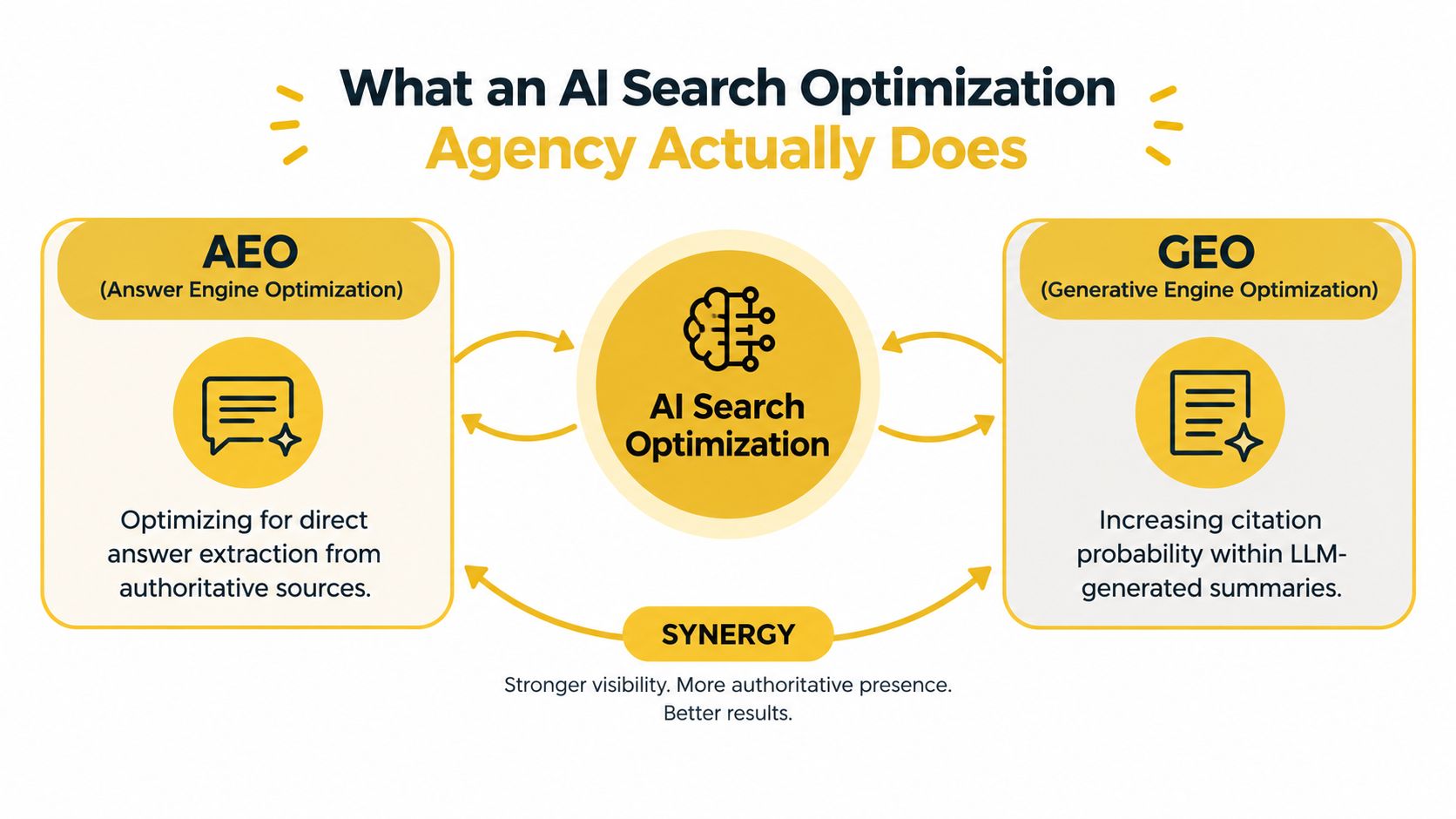
A serious agency coordinates several workstreams:
Map the entity. Document brand names, products, categories, people, locations, use cases, differentiators, and evidence. This prevents the website, profiles, media coverage, and product documentation from telling different stories.
Engineer source assets. Create pages that answer specific questions directly, with definitions, specifications, comparisons, authorship, dates, references, and crawlable links.
Build independent corroboration. Earn credible editorial coverage, expert references, community discussion, and reference-quality profiles. First-party claims alone rarely establish broad trust.
Fix machine access. Resolve indexability, rendering, canonicalization, internal linking, and structured-data problems that prevent systems from retrieving or interpreting content.
Test generated answers. Run a stable prompt set across relevant engines, record mentions and citations, and compare competitors under the same conditions.
Technical guidance from Google Search Central makes one implementation rule clear: structured data can help Google understand content and qualify pages for search features, but the marked-up information must be visible and trustworthy on the page. Schema can't rescue unsupported claims or hidden text.
For a practical overview of the software side, see what AI SEO software is and how it supports visibility work. The agency's role is to connect that measurement with people who can change the site, content, PR, product data, and brand evidence.
The visual model matters, but the working definition is simple: an AI search optimization agency makes a brand easier for answer systems to understand and safer for them to recommend.
The Core Service Map Most Agencies Deliver
The service catalog should be judged by the signal it changes, not by how many deliverables appear in a proposal. A credible program links each activity to a visibility problem.
Service | Primary Signal Influenced | Sample Deliverable |
|---|---|---|
AEO and GEO strategy | Prompt relevance and answer eligibility | Intent map, prompt panel, competitor citation analysis |
Technical writing | Extractable product and expertise facts | Documentation, comparison pages, FAQ blocks, specification content |
Digital PR | Independent authority and corroboration | Tier-1 editorial coverage, expert commentary, source placements |
Wikipedia and reference assets | Entity recognition and factual stability | Neutral reference profile, entity reconciliation, sourced facts |
Reddit and community engagement | Real-world relevance and user validation | Helpful discussions, expert responses, community listening |
Structured data and crawlability | Machine interpretation and retrieval | Schema validation, indexability audit, internal-link improvements |
AI visibility analytics | Inclusion, citations, sentiment, and competitive context | Prompt-level dashboard, source tracking, change log |
What each discipline changes
AEO and GEO strategy define the questions that matter. A SaaS company competing in “best project management software for distributed teams” needs more than a product page. It needs explicit use-case evidence, implementation details, independent comparisons, and documentation that supports the answer a model might generate.
Technical writing turns product knowledge into retrievable facts. A vague statement such as “built for modern teams” gives a model little to use. A clearly structured explanation of permissions, integrations, deployment, or support gives it specific material for a comparison answer.
Digital PR and reference building supply external confirmation. A publisher's review, an expert quotation, or a neutral reference page can support entity recognition in ways a brand's own marketing copy cannot. The work must remain accurate and editorially defensible. Paid or manufactured mentions create risk rather than durable authority.
Reddit and community work require restraint. The objective isn't to flood discussions with branded links. A product expert can answer a technical question, disclose affiliation where appropriate, and add useful context that helps people evaluate the category.
Consider an e-commerce brand whose product pages still rank but receive fewer clicks when AI Overviews appear. The agency might rewrite category content around concise specifications, validate visible product and availability markup, improve internal links, and build independent reviews. The success criterion isn't “more schema.” It's more accurate product representation and stronger inclusion in purchase-oriented prompts.
A second example is a B2B SaaS company absent from comparison answers. The agency could identify conflicting feature descriptions, publish accessible documentation, secure expert coverage, and test whether the brand is recommended alongside established competitors. Each activity should connect to a defined prompt and a measurable change.
Practical rule: Ask every agency, “Which model signal does this deliverable improve, and how will you test it?”
Why Traditional SEO Is Necessary but Not Sufficient
Traditional SEO remains the base layer. Search engines still need crawlable pages, clear information architecture, useful content, valid links, and technically sound delivery. Removing that foundation makes AI visibility harder, not easier.
The mistake is treating a Google ranking as a reliable forecast of inclusion everywhere else. A 2026 review of empirical studies reported mean overlap between domains cited by GPT-4o and Google's top-ten results of only 4.0%. The corresponding overlap was 11.1% for Gemini, 12.6% for Claude, and 15.2% for Perplexity, according to the review of the emerging cross-engine evidence. The review is a secondary synthesis, so use it directionally and validate the pattern against your own prompt set.

A top-ten ranking may establish relevance for Google's results without supplying the evidence an AI system needs for a synthesized answer. A SaaS vendor can rank well but lack third-party reviews, analyst commentary, community context, or documentation. An e-commerce brand can have strong category pages but inconsistent product facts across retailers and editorial sources.
That means the agency doesn't replace the in-house SEO team. It extends the team into signals the website can't fully control:
Independent authority: Who else describes the brand, and are those descriptions accurate?
Source diversity: Does the brand appear in documentation, editorial media, communities, profiles, and comparison content?
Platform fit: Does the same evidence work across ChatGPT, Perplexity, Gemini, and Claude?
Factual consistency: Do product names, features, prices, dates, and claims agree across sources?
The strongest operating model keeps technical SEO ownership internal while using an agency for external authority, specialized testing, and cross-platform analysis. Treat AI search as an expansion of search strategy, not a reason to abandon the fundamentals that make information accessible.
Measuring Outcomes Beyond Citations and Share of Voice
Citation volume is not a business outcome. It can indicate that a system retrieved your source, but it doesn't tell the CMO whether the brand was recommended, whether the prompt had commercial intent, or whether any revenue followed.
A representative-panel study of 900 U.S. adults found that users clicked sources cited inside Google AI Overviews in only about 1% of visits, while AI Overviews were associated with fewer outbound clicks and more sessions ending on the results page, according to the study on citation clicks and AI search behavior. That makes citation tracking useful, but insufficient.
Use four distinct outcomes.
Model visibility
First ask whether the brand appears in the generated answer at all. Track prompt, engine, market, language, device, date, competitor presence, answer sentiment, and the URL or source cited. A brand that appears only for low-value educational questions shouldn't receive the same score as one appearing for purchase comparisons.
Recommendation inclusion
A mention isn't the same as selection. Record whether the model names the brand as a suitable option, places it in a shortlist, describes it positively, or recommends a competitor instead. A smaller number of high-intent recommendations can matter more than broad visibility across generic prompts.
Downstream branded demand
Look for changes in branded search, direct visits, qualified traffic, assisted conversions, and sales conversations. Adobe reported that 34% of consumers used AI for product research before conventional search, and that AI-driven referrals to retail sites grew nearly 3,500% between July 2024 and May 2025, in its Digital Insights Quarterly Report. Those figures support a practical warning: referral analytics can miss influence when someone sees a recommendation, later searches the brand directly, and converts through another channel.
Revenue attribution
Connect prompt cohorts to CRM and conversion data. Use tagged landing pages where possible, survey questions about AI influence, matched-market tests, and incrementality experiments. Report confidence levels rather than claiming that a mention caused a sale.
A useful measurement brief names the prompt set, markets, engines, owners, baseline, reporting cadence, and decision thresholds. It should also compare matched keyword cohorts with and without AI Overviews. A large-scale field experiment reported that AI Overviews reduced organic click-through by 38% and increased zero-click searches by 33%, without improving reported satisfaction, in the field experiment on AI Overview effects.
For a deeper measurement framework, use this guide to measuring generative engine optimization. The core principle is direct: visibility is the first outcome, revenue is the final test, and citations sit between them as evidence, not proof.
A Buyer's Framework for Evaluating an AI Search Optimization Agency
A pitch deck can make almost any agency sound ready for AI search. Your scorecard should force operational detail.
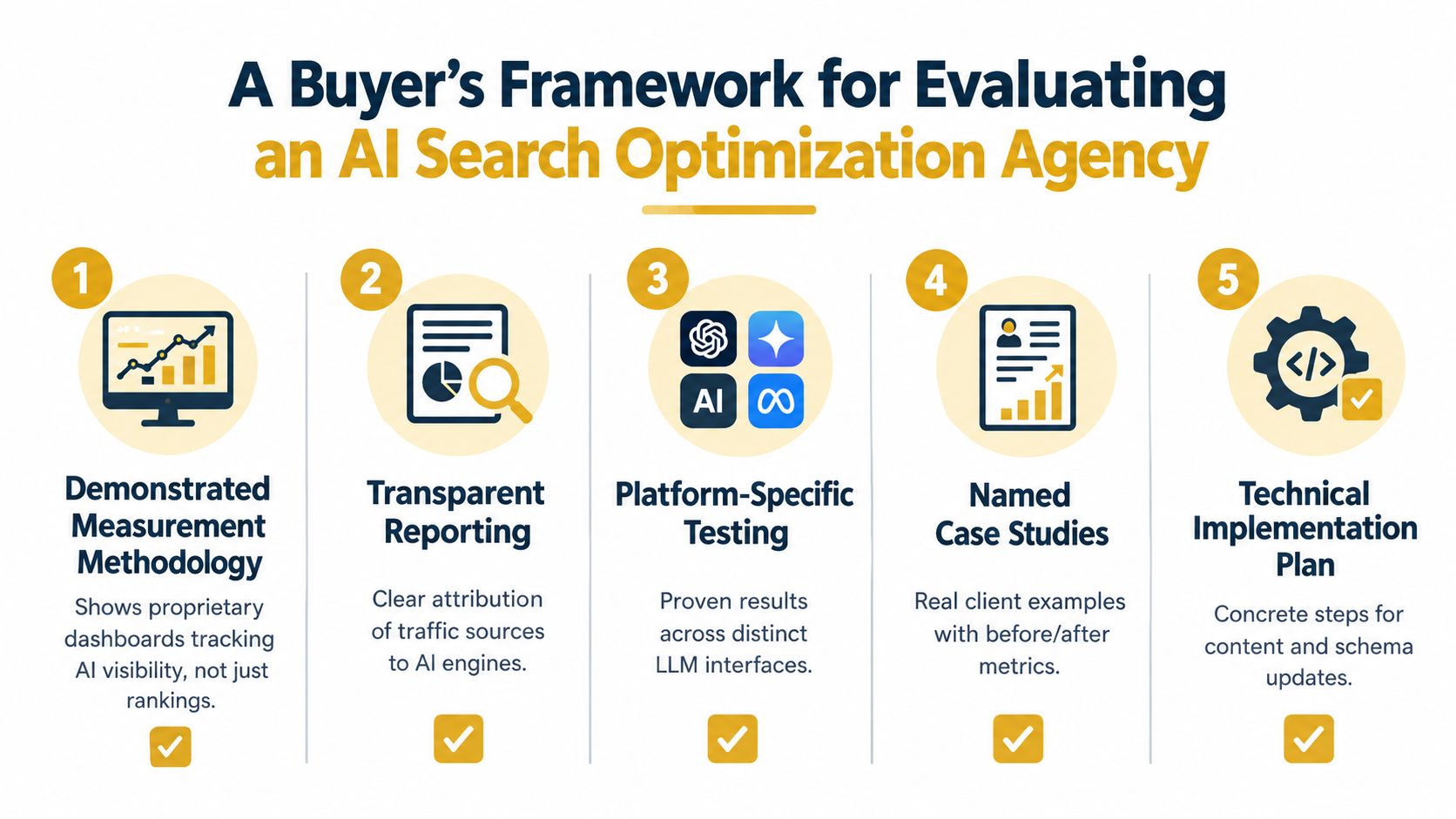
Start with evidence, not terminology
Score vendors against these criteria:
Measurement methodology. Can the agency show how it selects prompts, controls variables, records answers, and separates visibility from recommendation?
Transparent reporting. Do reports expose source URLs, competitor presence, sentiment, market, language, and changes over time?
Platform-specific testing. Does the team test ChatGPT, Perplexity, Gemini, Claude, and relevant Google experiences separately rather than presenting one blended score?
Named case studies. Can it provide client names, baseline conditions, deliverables, time frame, and outcome definitions? “Visibility increased” isn't enough without explaining what visibility means.
Technical implementation. Does the proposal identify indexability, rendered content, canonical consistency, structured-data validation, internal links, and content ownership?
Ask these questions in the pitch:
How do you connect AI visibility to pipeline and revenue? Look for matched cohorts, CRM tagging, assisted conversion analysis, surveys, and clear confidence limits.
How do you choose the prompt set? The agency should use customer research, sales language, product categories, competitors, markets, and intent stages. It shouldn't select prompts that make the brand look good.
What happens if citations don't move? A credible answer includes diagnosis, source-gap analysis, content or PR changes, and a decision to stop weak tactics.
How do you distinguish a citation from a recommendation? The reporting should show whether the brand supplied a fact, appeared in a shortlist, or was selected as the preferred option.
What won't you do? Reject vendors that promise guaranteed rankings, guaranteed model inclusion, fabricated reviews, undisclosed community promotion, or unsupported claims.
A useful procurement test: Ask the agency to show one underperforming prompt and explain what it would change first. Strategic maturity appears faster in diagnosis than in a polished success story.
Opaque dashboards are another warning sign. If you can't export prompt-level observations, identify cited sources, or see the competitor set, you can't independently audit the program. Choose the vendor that makes uncertainty visible, not the one that hides it behind a single visibility number.
How Agencies Integrate With In-House Teams and Platforms
The agency should add capacity without taking control away from the people who understand the brand. In-house teams retain brand voice, legal approval, product accuracy, customer data, and final publishing authority. The agency typically owns research, technical recommendations, content production, authority campaigns, prompt testing, and performance analysis.
A workable handoff includes:
Entity brief: Approved names, products, claims, audiences, experts, prohibited language, and source requirements.
Prompt library: Prioritized questions grouped by intent, market, language, competitor, and customer journey stage.
Technical backlog: Indexability, rendering, canonical, internal-link, structured-data, and content-access issues with owners.
Authority plan: Target publications, reference sources, communities, experts, and editorial angles.
Measurement specification: Metrics, baseline, confidence levels, reporting cadence, and CRM fields.
The weekly cadence should stay short and concrete. Marketing owns priorities, product validates facts, engineering handles implementation, content approves drafts, PR manages outreach, and the agency records tests and outcomes. A monthly decision meeting should remove work that isn't improving a defined signal.
At 30 days, expect a baseline prompt audit, entity review, structured-data and crawlability diagnosis, competitor source map, and measurement plan with named owners. At 60 days, the team should have shipped priority fixes, created or revised source assets, and begun authority work. At 90 days, leaders should see test results, source changes, recommendation patterns, and a decision about scaling.
A platform such as an AI visibility SaaS workflow for agencies and marketing teams can feed prompt-level analytics, crawlability findings, and structured-data guidance into execution. The important point isn't the platform label. It's the operating loop: measure, diagnose, publish, corroborate, retest.
Choosing the Right Engagement and What Happens Next
An agency engagement makes sense when AI-mediated discovery already affects a valuable customer journey. Strong candidates include brands with measurable AI Overview exposure, content-rich SaaS companies competing in comparison prompts, and e-commerce categories where organic click-through is shrinking while product research moves into assistants.
You should wait if the site has severe indexability problems, weak product data, no clear positioning, or no internal owner for approvals. An agency can't compensate for an inaccurate catalog, unresponsive engineering team, or product that customers don't understand. Fix the basic operating constraints first.
The first 30 days should look like an investigation, not a content factory:
Baseline the prompts: Capture current answers, mentions, recommendations, citations, competitors, sentiment, and cited URLs across the engines your customers use.
Reconcile the entity: Compare brand, product, expert, feature, pricing, and category information across owned and independent sources.
Audit technical access: Review indexability, rendered content, canonical signals, structured data, internal links, and the relationship between visible copy and markup.
Set commercial measurement: Define branded-demand indicators, CRM tagging, assisted-conversion logic, matched cohorts, owners, and reporting confidence.
Select a focused pilot: Choose one product line, market, or customer journey where the business outcome is clear and the team can ship changes.
Stanford's 2025 AI Index reported $33.9 billion in global private investment in generative AI in 2024, an 18.7% increase from 2023, and found that 78% of organizations reported using AI in 2024, up from 55% in 2023. The share using generative AI in at least one business function rose from 33% in 2023 to 71% in 2024. Those figures explain the strategic pressure, but they don't justify spending without a measurement plan.
Pick an agency when it can connect technical work, source authority, prompt testing, and revenue analysis. Don't buy a promise to “win AI search.” Buy a controlled program that tells you where the brand is absent, changes the evidence systems can retrieve, and shows whether high-value discovery improves.
Verbatim Digital combines an AI visibility platform with hands-on work across entity clarity, citation tracking, technical readiness, digital PR, and content execution. Visit Verbatim Digital to request a free AI visibility audit and bring your first prompt baseline, source gaps, and measurement questions into the vendor conversation.
Run a Free GEO Audit
Recent Blogs

Digital Marketing for B2B: End-to-End Playbook
A buying committee visits your website, reads a comparison page, asks ChatGPT...
View Details
Best Answer Engine Optimization Tools: 10 Picks
AEO tools don't solve one universal visibility problem. A platform that measures...
View Details
Top Answer Engine Optimization Software for 2026
AI Overviews appeared in 6.49% of queries in January 2025 and 13.14%...
View Details
AI Search Optimization: A Practical Guide for 2026
A mid-market SaaS company can keep its branded search demand stable while...
View Details
AI SEO Software: What It Is and How to Choose One
Most advice about AI SEO software is wrong. It treats the category...
View Details
AI Visibility Audit Free Guide to Get Found in AI Search
Your rankings look healthy. Organic traffic is stable. Yet when a buyer...
View Details
AEO Benefits That Drive Discovery in AI Search
A SaaS company can hold the first organic position for an important...
View Details
Best Generative Engine Optimization Company for AI Visibility: 7 Picks
The most popular advice about generative engine optimization is also the least...
View Details
AI Visibility Report Explained and How to Use It
A CMO opens the weekly search dashboard and sees reassuring numbers. Organic...
View Details
How to Measure Generative Engine Optimization
Your CMO asks a question: “Are we showing up in ChatGPT, Perplexity,...
View Details