
October 7, 2026
Digital Marketing for B2B: End-to-End Playbook
A buying committee visits your website, reads a comparison page, asks ChatGPT for alternatives, checks LinkedIn, and returns through a branded Google search. Your sales team may only see the final for...
Table of content
October 7, 2026
A buying committee visits your website, reads a comparison page, asks ChatGPT for alternatives, checks LinkedIn, and returns through a branded Google search. Your sales team may only see the final form submission, while most of the evaluation has already happened elsewhere. That gap is where many B2B marketing programs lose influence.
Effective digital marketing for B2B now has to do two jobs at once. It must capture existing demand through search, paid media, and conversion assets, while also building enough authority to appear in AI-generated recommendations and earn trust before a buyer is ready to speak with sales. The operating model is no longer “generate leads, then hand them over.” It's a connected system for being found, understood, shortlisted, validated, and selected.
Run a Free GEO Audit
Understanding the Modern B2B Buyer Journey
A buying committee may spend weeks researching a supplier before anyone accepts a sales meeting. Buyers define the problem, compare approaches, check technical details, ask colleagues for recommendations, and test vendor claims across search results and AI-generated answers. In Gartner's survey of 632 B2B buyers, conducted in August and September 2024, 61% preferred an overall rep-free buying experience, while 73% actively avoided suppliers that sent irrelevant outreach. Broad reach has limited value unless the information helps buyers at the moment they define a problem, compare options, or build an internal case.
Gartner also found that 69% of B2B buyers experienced inconsistencies between information on a company's website and information provided by sellers. A prospect who reads one positioning statement on a landing page and hears another from sales must resolve the contradiction before evaluating the product. Some will remove the vendor from consideration.
The practical consequence is significant. Your website, search content, product documentation, comparison pages, customer evidence, and sales enablement materials now form one buying environment. That environment includes conventional search and generative engines, so marketing teams should track whether the company is discoverable, accurately represented, and supported by credible evidence in both places. Marketing owns more of the early commercial experience, but sales messaging, product claims, and campaign promises must support the same buyer questions.
The journey loops instead of moving in a straight line
Gartner describes six recurring buying jobs:
Problem identification: defining what has changed or what needs fixing.
Solution exploration: learning which categories and approaches could address the problem.
Requirements building: deciding what the organization needs from a solution.
Supplier selection: narrowing the field of potential vendors.
Validation: checking whether the preferred option is credible and suitable.
Consensus creation: helping internal stakeholders agree on a decision.
These jobs recur rather than follow a neat sequence. 90% of buyers revisited at least one buying job during the purchasing process, according to Gartner's research on the B2B buying journey. A finance stakeholder may send the team back to requirements building. A technical reviewer may reopen solution exploration after finding an integration concern. Procurement may request new validation evidence late in the process.
Practical rule: Build content for the decision task, not just for the funnel stage.
For measurement, map each asset to a buying job and track the resulting progression. Monitor qualified opportunities, assisted pipeline, branded search, and the accuracy of appearances in AI-generated recommendations. These measures show whether content helps a committee advance, rather than attract visits.
Sales still matters, but later and more selectively
Digital self-service changes where sales creates value. Buyers still want human involvement when they need contextual judgment, such as assessing organizational fit, handling implementation constraints, or resolving commercial concerns.
The time available to a supplier is limited. Buyers spend only 17% of total purchase time meeting potential suppliers, and when comparing several vendors, they spend approximately 5% to 6% of their time with any one sales representative, as documented in the same Gartner study. Marketing should answer common questions before a meeting. Sales should use meetings to add context, judgment, and risk assessment rather than repeat material already available online.
A SaaS company selling workflow software might publish integration documentation, security explanations, role-specific use cases, and a clear comparison page. Sales can then focus on the prospect's operating model and adoption risks. A manufacturer might provide technical specifications and compliance documentation online, allowing the account team to concentrate on production planning and procurement requirements.
Replace the lead-count question with this one: which buying jobs did marketing help the committee complete, and where did sales add judgment that digital content could not provide?
Demand Generation Channel Strategy
Channel planning becomes clearer when you separate demand capture from demand creation. Capture channels reach people who already recognize a problem and are looking for information, suppliers, or solutions. Creation channels build familiarity and preference before a buyer has expressed active intent.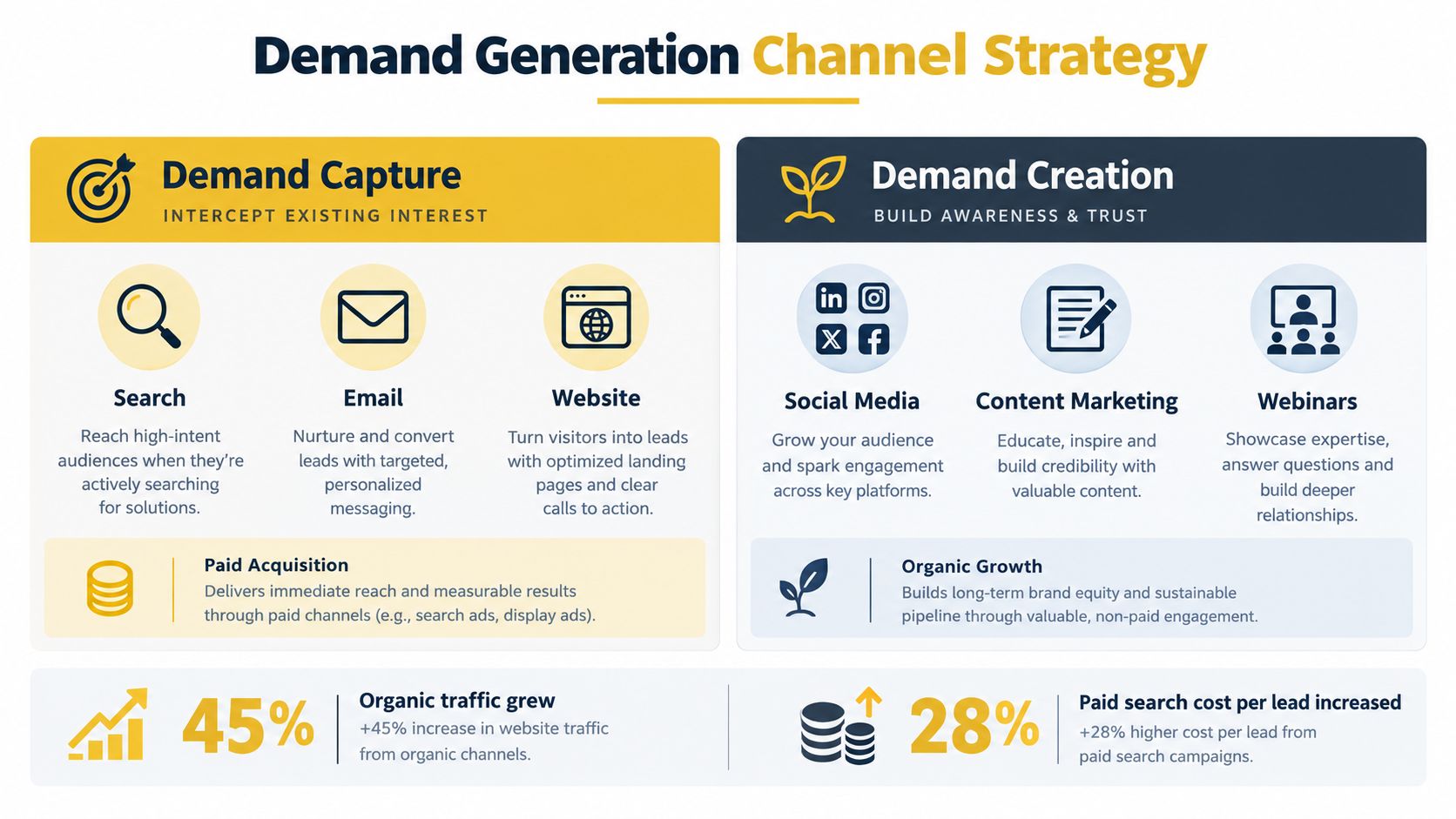
Use capture channels where intent is visible
Organic search, paid search, product pages, comparison content, email nurture, and conversion-focused website experiences are useful when buyers are already researching. Start with the questions that appear close to a commercial decision, then work backward toward educational topics that help buyers define the problem.
A practical sequence looks like this:
Map commercial queries. Identify searches for categories, alternatives, integrations, pricing, security, and implementation.
Build decision assets. Create pages that answer those questions directly, with clear evidence and a logical next action.
Connect paid and organic coverage. Use paid media to test messaging and capture immediate demand while organic content compounds over time.
Measure quality beyond the form. Track qualified leads, sales acceptance, opportunities, and revenue contribution.
A technical SEO and SEO services program from Verbatim Digital can support the capture layer by improving crawlability, content structure, internal linking, and search intent coverage. The same principle applies whether your team uses an agency, an internal SEO function, or tools such as Google Search Console and Semrush. Fix the foundation before scaling acquisition.
Fund creation for future demand
Brand campaigns, webinars, executive content, partnerships, social distribution, and original research serve buyers who aren't ready to convert. They help your company enter the mental shortlist before a problem becomes urgent. This work is harder to attribute because the exposure may precede a search or sales conversation by a long period.
LinkedIn's B2B Marketing Benchmark found that lead generation received 36% of B2B marketing budget allocation, while brand building received 30%, based on research involving 1,577 senior B2B marketing leaders and 377 CFOs across several markets. The LinkedIn benchmark supports treating the two activities as complementary time horizons, not competing philosophies.
LinkedIn's native Lead Gen Forms offer a useful conversion test. The platform reports that these forms can convert at up to 5× the rate of traditional landing pages, and that LinkedIn lead-conversion rates can be approximately 3× higher than those of other major advertising platforms, as stated in LinkedIn's lead generation benchmark. Pre-populated profile fields reduce manual entry, but a cheaper conversion doesn't automatically mean better pipeline.
Run the test with the same audience, creative, offer, and bid approach. Compare form completion with marketing-qualified leads, sales-accepted leads, opportunity rate, and revenue per impression. A native form that produces more submissions but fewer qualified opportunities is reducing friction for the wrong audience.
Account-Based Marketing Integration
Account-Based Marketing works best as a layer over broad digital demand generation, not as a replacement for it. Inbound content helps people discover and understand your category. ABM concentrates effort when a specific account has the potential, urgency, and organizational complexity to justify personalization.
The common mistake is to select target accounts based only on company size. A better account definition combines commercial fit with buying conditions. Look for a clear use case, an addressable buying committee, a sales owner, evidence of relevant activity, and a realistic path to executive sponsorship.
Choose the right level of personalization
Not every account needs a custom microsite or bespoke campaign. Use scalable content when several target accounts share the same problem, industry context, or technical requirement. Reserve high-touch assets for situations where the account's operating model or approval process materially changes the message.
Situation | More effective approach | Main trade-off |
|---|---|---|
Many accounts share one urgent use case | Search content, paid social, webinars, and role-based nurture | Less individual personalization |
A small group of strategic accounts has complex buying committees | Account-specific messaging, coordinated sales outreach, and executive content | Higher production and coordination cost |
An account is researching but has low commercial fit | Useful educational content and light nurture | Avoids wasting sales capacity |
An account has strong fit and active engagement | Sales and marketing orchestration around the committee | Requires shared definitions and fast follow-up |
Marketing and sales should agree on the account list, the buying roles, the trigger for coordinated action, and the evidence required to move an account from marketing attention to sales engagement. A technical evaluator may need integration documentation. A finance sponsor may need a business case. An executive may need risk, strategic fit, and proof that implementation won't disrupt operations.
Measure movement, not activity
ABM reporting often becomes a list of impressions, account visits, and email engagement. Those measures can help diagnose reach, but they don't prove commercial progress. Track account engagement alongside meeting quality, opportunity creation, stage progression, pipeline velocity, and win-rate differences where the data supports comparison.
For example, a cloud infrastructure company might use broad technical content to attract engineering teams, then activate ABM when several people from a named account engage with migration documentation. Sales can tailor the next conversation to the account's architecture instead of sending a generic product email. The value comes from coordination and relevance, not from labeling every campaign “ABM.”
Content Strategy for Traditional and AI Search

Traditional SEO and AI discovery rely on the same foundation, yet they create different visibility conditions. Search rankings depend on satisfying a query and earning placement in results. AI systems may extract a page as evidence, summarize its claims, compare it with other sources, or recommend a company without generating a visit.
AI-assisted research already affects B2B decisions. A 2026 survey of 622 U.S. B2B professionals found that 72% used AI during early research, 48% used it to narrow the shortlist, 62% used it when comparing vendors, and 45% used it during the final decision. 75% still used conventional search engines, according to Semrush's analysis of AI and B2B buying. Enterprise teams should measure both surfaces: organic rankings, qualified clicks, and conversions alongside AI mentions, cited pages, and the accuracy of the information presented.
Make important claims easy to verify
AI visibility depends on more than keyword placement. Each important page should identify the organization, product, category, audience, evidence, and limitations clearly. Use descriptive headings, direct answers, consistent terminology, original analysis, and links to authoritative sources. State who made a claim, how it was established, and where it applies.
Trust sets a high bar for complex purchases. Independent 2025 buyer research cited in the same Semrush report found that original research was the most trusted content element at 70%, followed by expert opinions at 64% and peer insights at 62%. Only 42% of buyers highly trusted vendor websites. A product page therefore needs support from evidence that buyers can assess independently.
An enterprise software company could publish a benchmark, have subject-matter experts explain its methodology, and seek commentary from credible industry publications. A niche manufacturer could pair technical documentation with expert interviews, certifications, and customer validation. The objective is an evidence ecosystem that a buyer can inspect, not decorative citations.
Start with technical eligibility
Google says there is no separate optimization file or AI-only schema for AI Overviews and AI Mode. A page must be indexed and eligible to appear in ordinary Search with a snippet before it can appear as a supporting link in those features, according to Google's documentation on AI features.
Crawlability, indexation, canonicalization, page performance, and accurate structured data therefore establish the baseline. Structured data must match visible content, and it does not guarantee crawling, indexing, or inclusion. If a pricing page is blocked from crawling, schema will not make it useful for an AI-generated answer about pricing. If Organization or Product markup conflicts with visible claims, it can create ambiguity instead of authority.
Build for citation, not just the click
A strong AI-search page answers one specific question in language that can be quoted without losing meaning. Give the answer early, then add supporting detail, qualifications, examples, and source links. Remove unsupported superlatives and separate company facts from editorial interpretation.
Marketing teams should monitor prompt-level share of voice, cited pages, citation accuracy, entity consistency, and post-exposure research behavior. Compare those signals with rankings, qualified organic opportunities, assisted pipeline, and sales feedback. The practical guide to AI search optimization offers a useful reference for connecting technical SEO, structured data, and answer-focused content while keeping the work aligned with conventional search.
Real-World B2B Marketing Scenarios
These scenarios show how enterprise teams make practical decisions when resources are limited and the buying journey crosses search, sales, third-party sources, and AI interfaces. Each example connects execution choices with measurable visibility and pipeline outcomes.
Scenario one for a growing SaaS company
A SaaS company has strong product-market fit but weak non-branded organic visibility. The marketing team wants to publish more articles, while technical issues prevent important documentation and comparison pages from being reliably discovered. Sales also sends prospects to outdated pages with inconsistent positioning.
Before publishing another article, the team audits crawlability, indexation, canonical signals, internal links, page templates, and the relationship between product claims and sales materials. It then creates a focused set of decision pages covering integrations, security, alternatives, implementation, and role-specific use cases.
The trade-off is slower content volume. The company publishes fewer pieces while repairing the foundation and securing credible third-party coverage. It measures qualified organic opportunities, branded search behavior, assisted pipeline, and citation accuracy instead of using article count as the main success measure. Sales receives a shared message map, so page language and sales conversations reinforce the same positioning.
The team also compares conventional rankings with mentions in AI-generated answers. That comparison shows whether technical and editorial improvements increase discovery across both channels without separating marketing activity from sales priorities.
Scenario two for a cybersecurity provider
A cybersecurity firm ranks for a broad category query, while an AI summary answers the general question before the user reaches the traditional results. The marketing team evaluates whether its research and expertise appear in that answer layer, then decides which visibility gaps deserve investment.
The team tests prompts across ChatGPT, Perplexity, Gemini, Claude, and Google's AI features. It records whether the company is mentioned, which sources are cited, whether the description is accurate, and whether the recommendation matches the firm's actual strengths. It improves research pages, expert commentary, implementation guidance, and independent validation based on those findings.
A fall in clicks on a broad query does not automatically mean a fall in commercial influence. The dashboard separates organic sessions, branded search, direct traffic, cited-source visibility, assisted conversions, and pipeline from accounts exposed to the material. It also retains conventional SEO work because buyers continue to use standard search alongside AI tools.
The following video offers another perspective on how teams can connect search visibility with broader marketing execution.
Scenario three for an industrial manufacturer
A specialized manufacturer has excellent engineering knowledge but limited independent digital authority. Its website explains products accurately, yet buyers seeking technical guidance find more visible publishers and associations.
The marketing team turns subject-matter expertise into original research, expert-led explanations, technical videos, and clear reference pages. It pursues legitimate third-party mentions and partnerships where the company can contribute useful evidence. It avoids manufactured endorsements and generic guest posts that add little credibility.
The measurement plan reflects the long buying cycle. It tracks visibility for technical questions, citations and mentions, engagement from relevant accounts, sales conversations influenced by the content, and opportunity quality. The team reviews those signals alongside conventional rankings and AI visibility to identify where authority is improving and where the company still lacks discoverability.
The result supports engineers researching technical details and executives assessing supplier credibility. Each audience gets evidence suited to its decision, while marketing and sales work from the same commercial priorities instead of treating visibility as a standalone publishing goal.
Measuring Performance and Attribution
Last-click attribution breaks down when a buyer sees an AI recommendation, remembers the vendor, returns through a branded search, and submits a form weeks later. The final click is observable, but it doesn't explain what created preference or supplied the evidence that moved the account forward.
A useful measurement system has to separate visibility, engagement, commercial progression, and revenue. Keep the layers distinct. Otherwise, a high number of AI mentions can look valuable even when the descriptions are inaccurate or the cited pages attract no relevant accounts.
Build a four-layer dashboard
Visibility metrics show whether the brand can be found and understood. Track conventional rankings and impressions, branded search, direct traffic, AI prompt-level share of voice, mention frequency, cited URLs, and citation quality. For AI platforms, record the prompt, date, market, model or interface, competitors mentioned, and whether the answer represents the company accurately.
Engagement metrics show what people do after exposure. Monitor organic sessions, return visits, content depth, tool usage, document downloads, webinar participation, and interactions from target accounts. Don't treat every session as equal. A visit from a relevant buying committee matters more than anonymous traffic with no commercial fit.
Pipeline metrics connect activity to account progression. Use CRM fields to record first touch, influential content, campaign exposure, opportunity stage, sales acceptance, and account membership. Compare opportunity creation, stage progression, sales cycle movement, and win rates where your data supports a valid comparison.
Revenue metrics give finance and the board a commercial view. Report pipeline value, closed revenue, revenue per impression where appropriate, customer acquisition cost, and retention or expansion outcomes. Use cohorts, matched markets, holdout tests, and account-level comparisons instead of relying only on last touch.
Account for the AI measurement gap
One analysis reported that 73% of B2B buyers used AI tools during purchase research, while only 22% of marketers tracked AI visibility and fewer than 26% planned content specifically for AI citations, according to the multi-source AI visibility analysis published by PR Newswire. The same source reported that 41% of B2B buyers started with AI and validated through search, while 35% began with search and used AI for synthesis or comparison.
Those behaviors make channel-level credit unreliable. Add a short “How did you hear about us?” field, use structured campaign and content data in the CRM, and ask sales to record influential sources during discovery. Treat survey evidence as directional, then compare it with account and revenue data.
Google search behavior also needs context. Pew Research Center found that approximately 18% of Google searches produced an AI-generated summary, and 58% of users conducted at least one search that generated one in its March 2025 browsing analysis. When a summary appeared, users clicked a traditional result in 8% of visits, compared with 15% when no summary appeared, and clicked a link inside the summary in just 1% of visits, according to Pew Research Center's analysis.
Use those figures as a reason to expand measurement, not as proof that clicks no longer matter. The same analysis found that 88% of summaries cited at least three sources, which reinforces the value of accurate, authoritative pages even when the user doesn't click immediately.
For a practical framework for measuring generative visibility, use this guide to generative engine optimization measurement alongside your existing SEO and CRM reporting.
Actionable Next Steps for Leaders
Start with a short diagnostic rather than another campaign.
Audit technical eligibility: Confirm that important pages can be crawled, indexed, canonicalized, and rendered consistently.
Map buying jobs: List the questions buyers ask during problem definition, comparison, validation, and consensus creation.
Check message consistency: Compare website claims, paid ads, product pages, sales decks, documentation, and customer-facing emails.
Test AI visibility: Run representative prompts across major AI and search interfaces, then record mentions, competitors, citations, and factual errors.
Separate capture from creation: Fund high-intent search and conversion assets while maintaining research, expert content, partnerships, and brand activity.
Align the account model: Agree with sales on target accounts, buying roles, engagement triggers, handoff rules, and opportunity definitions.
Connect metrics to revenue: Add AI visibility, branded demand, assisted pipeline, opportunity progression, and win-rate analysis to the executive dashboard.
Review quarterly: Refresh outdated claims, improve citation quality, repair technical issues, and retire content that attracts attention without commercial relevance.
The central leadership decision is whether marketing will optimize only for the final measurable interaction or for the complete path to preference. Teams that combine search eligibility, credible evidence, useful self-service content, coordinated sales support, and AI visibility are better positioned to influence buyers before the form fill.
At Verbatim Digital we offer SEO, AI visibility tracking, structured-data guidance, citation building, digital PR, and content strategy for teams adapting to generative discovery. Reach out to assess where your brand appears across traditional and AI search, then turn the findings into an actionable growth plan.
Run a Free GEO Audit
Recent Blogs

AI Search Optimization Agency: A Practical Guide
Your organic traffic looks stable, yet the pipeline report tells a different...
View Details
Best Answer Engine Optimization Tools: 10 Picks
AEO tools don't solve one universal visibility problem. A platform that measures...
View Details
Top Answer Engine Optimization Software for 2026
AI Overviews appeared in 6.49% of queries in January 2025 and 13.14%...
View Details
AI Search Optimization: A Practical Guide for 2026
A mid-market SaaS company can keep its branded search demand stable while...
View Details
AI SEO Software: What It Is and How to Choose One
Most advice about AI SEO software is wrong. It treats the category...
View Details
AI Visibility Audit Free Guide to Get Found in AI Search
Your rankings look healthy. Organic traffic is stable. Yet when a buyer...
View Details
AEO Benefits That Drive Discovery in AI Search
A SaaS company can hold the first organic position for an important...
View Details
Best Generative Engine Optimization Company for AI Visibility: 7 Picks
The most popular advice about generative engine optimization is also the least...
View Details
AI Visibility Report Explained and How to Use It
A CMO opens the weekly search dashboard and sees reassuring numbers. Organic...
View Details
How to Measure Generative Engine Optimization
Your CMO asks a question: “Are we showing up in ChatGPT, Perplexity,...
View Details