October 26, 2026
AIO and GEO Explained: How to Win Visibility in AI Search
AIO refers to Google's AI Overviews feature, which places an AI-written answer above conventional results, while GEO is the practice of making a brand or source selected, cited, and accurately present...
Table of content
October 26, 2026
AIO refers to Google's AI Overviews feature, which places an AI-written answer above conventional results, while GEO is the practice of making a brand or source selected, cited, and accurately presented in generated answers. That distinction matters because users clicked a traditional result on 8% of searches with an AI Overview versus 15% without one, so exposure now happens even when a click doesn't.
For a CMO, that's not a terminology problem. It's a reporting problem. Your dashboard can show stable rankings while buyers read an answer that names competitors, summarizes your category without you, or describes your product inaccurately. It can also show falling clicks while your brand is gaining repeated citation in the answer layer.
Treat AIO and GEO as two layers of one visibility problem. AIO is where part of the exposure occurs. GEO is the work that influences whether you're selected and represented there and in other generative systems. You'll manage them well only if you measure rankings, citation, and representation separately, then connect all three to branded demand and revenue.
Run a Free GEO Audit
Why AIO and GEO Matter for Brand Visibility
Google made AI Overviews broadly available in the United States on May 14, 2024, generating an AI-written summary above conventional results with links to supporting webpages, a shift that changes both exposure and click behavior, as documented in the AI Overview statistics tracking that launch and rollout. That placement is the strategic point. The generated answer sits where the first organic result used to command attention, and it answers before it invites a click.
A brand can therefore be present in three different ways on the same results page. It can rank in the blue links, appear as a supporting source for the generated answer, or be named and described inside the answer text itself. Those aren't interchangeable wins, and they don't always move together.
Exposure Has Moved Up the Page
Consider a SaaS buyer searching for how to choose a CRM for a remote sales team. In classic search, she scans titles, opens two or three vendor pages, and forms a shortlist from what she reads. With an AI Overview, Google may summarize selection criteria, name vendors, and cite sources she never visits.
If your product is named accurately in that summary, you've influenced the shortlist without a session. If a competitor is named and you're only ranking fourth below the answer, your rank report overstates your actual visibility. Neither outcome shows up cleanly in click data.
A ranking tells you where your page sat. It doesn't tell you what the searcher read, believed, or remembered.
Why GEO Emerged as a Separate Discipline
GEO exists because the unit of competition changed. Traditional SEO competes for a position in a list. GEO competes for selection, attribution, and accurate representation inside a synthesized answer across Google and systems such as ChatGPT, Perplexity, Gemini, and Claude.
That creates a distinct set of questions for marketing leaders:
Selection: Does the system retrieve your pages or third-party pages that describe you when it builds an answer?
Attribution: Does it cite you visibly, or use your facts while crediting another source?
Representation: Does the generated text state your category, pricing logic, limitations, and differentiators correctly?
Ignoring that layer leaves a measurable gap, even if you can't yet measure it perfectly. You wouldn't judge paid search by impressions alone and ignore what the ad copy said. Don't judge AI search by rank alone and ignore what the answer said.
The practical risk isn't only lost traffic. It's lost framing. The first description a buyer encounters may now be written by a model, assembled from sources you don't control, and delivered before your own page gets a chance to make the case.
How AIO and GEO Differ in Mechanics and Goals
The comparison below sets the feature and the strategy side by side before the mechanics are unpacked in detail.

AIO is a specific Google feature. It lives inside Google Search, it appears for some queries and not others, and Google controls its format, its sources, and its wording. You can't buy placement in it, submit copy to it, or approve what it says about you.
GEO is a discipline, not a placement. It covers the work of making your brand, products, and evidence easier for generative systems to find, trust, cite, and reproduce accurately. That work applies inside Google and well beyond it, wherever a model synthesizes an answer from retrieved or learned sources.
A Library Catalog Versus a Research Librarian
Classic search works like a library catalog. It points you to shelves and lets you choose which book to open. A generative answer works like a research librarian who reads several books, writes you a summary, and footnotes some of them.
With a catalog, you optimize to be listed prominently and chosen. With a librarian, you also need your book to be pulled from the shelf, quoted rather than paraphrased beyond recognition, and represented fairly in the summary. The librarian also reads books you didn't write, including reviews, reference works, and competitors' comparisons.
That difference in control is why the two disciplines evaluate success differently. SEO asks whether you ranked and earned the click. GEO asks whether the system selected you, how prominently it presented you, and whether the presentation was accurate.
What the Research Actually Shows
The discipline has an evidence base, not just practitioner opinion. A 2024 study presented at the 30th ACM SIGKDD Conference evaluated optimization methods across 10,000 queries in 25 domains and found the strongest techniques improved generative-engine visibility by up to 40%, with citing sources, adding quotations, and adding statistics among the most effective approaches, as reported in the GEO study presented at ACM SIGKDD.
Read that carefully. The finding doesn't prove that adding any statistic to any page lifts your visibility in Google's live product. It shows, in a controlled benchmark, that verifiable evidence and explicit attribution change how prominently a source appears in generated answers. That's enough to justify testing evidence-led content changes. It isn't a guarantee you can put in a forecast.
What the finding does rule out is the assumption that generative visibility is random or purely a byproduct of keyword ranking. Content decisions moved the outcome. The decisions that moved it most were the ones that made a page easier to trust and quote, not the ones that repeated a target phrase more often.
Optimize for: SEO targets rank and click. GEO targets retrieval, citation, and faithful representation.
Controlled by: Google controls AIO entirely. You control your evidence, structure, and third-party footprint.
Proved by: SEO shows sessions and conversions. GEO shows citation frequency, mention quality, and downstream branded demand.
How Query Fan-Out Shapes Which Pages Get Cited
The image below shows how a single query can branch into related subtopics before an answer is assembled.
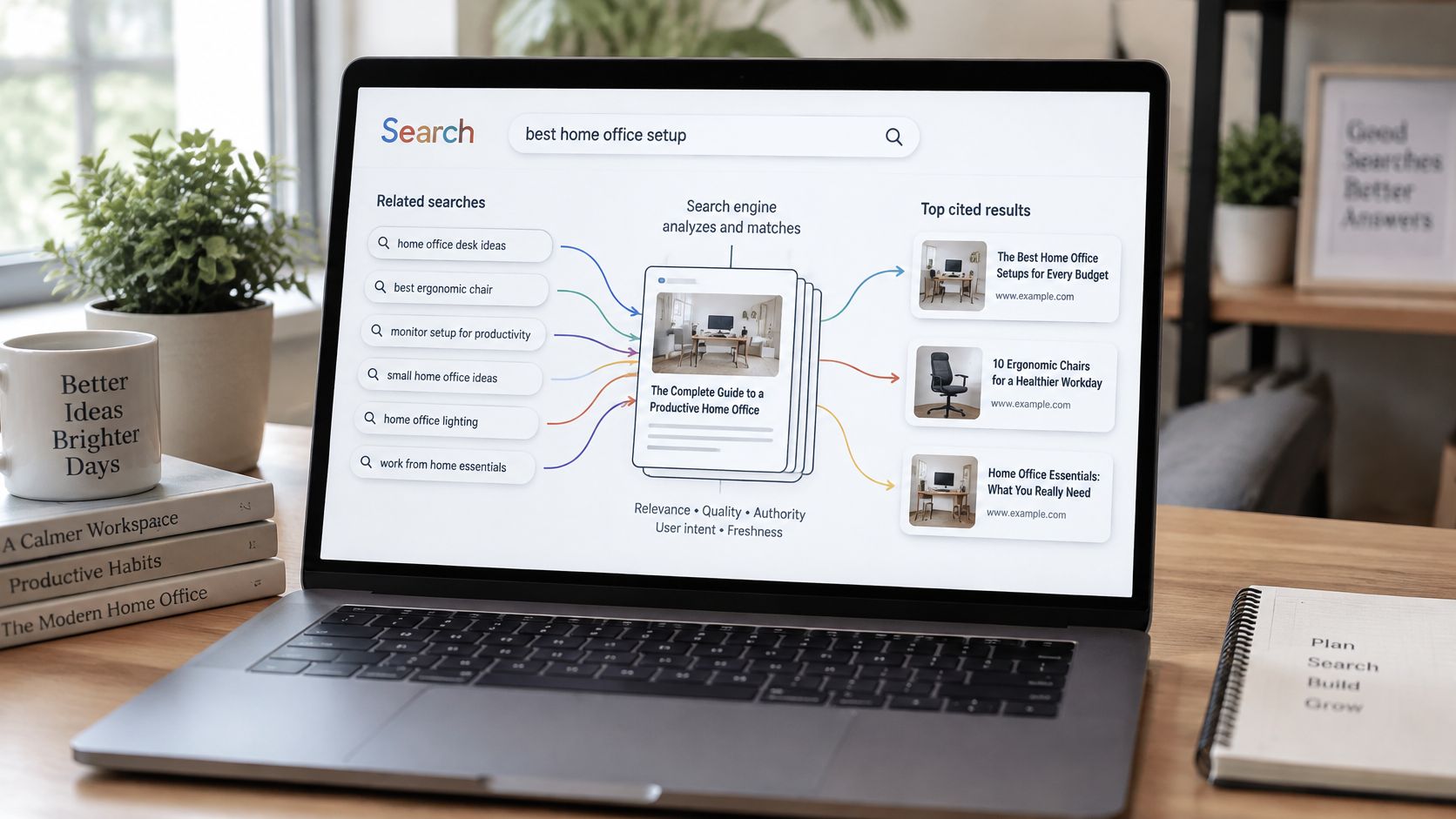
Google states that AI Overviews and AI Mode may use query fan-out, issuing multiple related searches across subtopics and data sources, and that a page must be indexed and eligible to appear with a normal Search snippet before it can serve as an AI Overviews supporting link, as set out in Google's documentation on AI features in Search. Fan-out is the mechanism that should change how you plan content.
Take a head query such as best CRM for remote teams. A fan-out process can branch into definitions, integration requirements, pricing logic, security limitations, migration effort, and comparisons with named alternatives. Each branch is effectively its own retrieval task, and each can pull a different supporting page.
One Head Topic Needs Many Answerable Pages
A single pillar page targeting the head term can't answer all of those subquestions with equal depth. If your pricing logic is buried in a sales deck, your limitations are unstated, and your integration detail lives in a help center that blocks crawling, the model fills those gaps from other sources. Those sources get the citation and shape the description.
Build coverage so each subquestion has an independently answerable home:
Definitions and scope: State plainly what your product or service is, who it's for, and what it isn't.
Comparisons: Publish honest side-by-side pages against the alternatives buyers name.
Implementation and limitations: Document setup steps, constraints, and edge cases in crawlable text.
Evidence: Give each claim a stated source, figure, or named customer outcome where you can verify one.
Structured technical writing that documents products in crawlable detail stops being a support function and becomes a visibility asset. Documentation pages often answer fan-out subquestions better than marketing pages do, because they're written to resolve a specific task rather than to persuade.
The Technical Baseline Is Not Optional
Fan-out rewards coverage, but eligibility comes first. Blocked crawling, noindex tags, incomplete JavaScript-rendered content, and weak canonical or internal-link signals can remove a page from classic discovery and AI citation at the same time. There's no separate AI index to appeal to if your basics fail.
That also means a page can win a fan-out branch without ranking for the head term. A narrow page on migration effort may never reach the first page for the main keyword, yet still be exactly what the system needs for one subquestion. If you only fund pages with head-term potential, you'll systematically underbuild the pages most likely to be cited.
Practical rule: Map every priority topic to the subquestions a buyer asks next, then check that each one has a crawlable page that answers it on its own.
Why Traditional Rankings Miss Generative Answer Sources
A page can rank well and still be absent from a generated answer. Rankings and AI citations measure related but distinct forms of visibility: search results show where a page ranks, while an answer may draw on sources beyond those results. A large benchmark comparing traditional results, AI Overviews, and Gemini examines this difference, but its specific figures are not used here because they cannot be verified. The practical conclusion is narrower: a rank report alone cannot establish whether a brand is represented in AI answers.
Rank remains useful as a measure of classic search visibility and a signal of discoverability. It is an incomplete proxy for answer visibility, though, because generative systems may select sources that do not appear among the leading results. A brand therefore needs to track both layers without treating either as a substitute for the other.
What the Source Portfolio Looks Like
Generative systems can draw on independent publications, expert documentation, reference pages, review platforms, community discussions, and structured product or organization data. A company site is one input among many; other sources may shape how a model describes the brand.
Consistency across those sources matters. If a company describes its category one way, a review platform uses another label, and a reference page describes an outdated product, the model encounters conflicting signals. Competitors with more consistent descriptions across sources may be easier to represent accurately.
Audit corroboration alongside rankings:
Entity naming: Does your site use the same names for your brand, products, and category as your structured data and major third-party profiles?
Factual consistency: Do independent publications describe current pricing, audience, and capabilities, or repeat outdated information?
Expert documentation: Can a model retrieve credible specialists' descriptions of your offering in their own words?
Organic search work that builds topical authority and crawlable depth supports this visibility by helping pages remain discoverable and relevant. It does not guarantee citation. The reporting gap appears when teams stop at ranking reports and assume AI answers will reflect those rankings.
Three Layers of AIO and GEO Measurement
Measurement layer | What it shows |
|---|---|
Classic ranking visibility | Whether your pages appear in conventional results and at what positions |
Supporting source inclusion | Whether your pages are cited as sources for generated answers |
Generated answer representation | Whether an answer names your brand and describes it accurately |
Report the layers separately, then relate them to business outcomes. A ranking report shows classic search performance; citation tracking shows source inclusion; answer review shows how the brand is represented. Keeping those measures distinct makes changes actionable, while linking them to branded demand and revenue prevents visibility reporting from becoming an end in itself. For example, rankings may hold steady as citations fall, or citations may rise while an answer describes the product inaccurately. Each pattern calls for a different response.
Measuring Clicks, Citations, and Brand Mentions Together
Click data now misleads in a specific, predictable direction. Pew Research Center analyzed 68,879 Google searches from 900 U.S. adults in March 2025 and found users clicked a traditional result in 8% of visits with an AI summary compared with 15% without one, and clicked links inside the AI summary in only 1% of visits, as reported in Pew Research Center's analysis of click behavior with AI summaries.
Two conclusions follow, and both are easy to miss. First, being cited is not a traffic strategy, because citation links are rarely clicked. Second, a falling click rate doesn't prove falling visibility, because the searcher may have read about you in the answer and acted later through branded search, direct visits, or a sales conversation.
A Framework That Separates the Signals
Stop asking one metric to do three jobs. Report each signal against the decision it informs:
Rankings: Are we eligible and competitive in classic results for priority topics?
AI summary inclusion: For queries that trigger an answer, how often are we a cited source?
Citation frequency and representation: How often are we named in answer text, and is the description accurate?
Branded searches: Does exposure in answers produce later demand under our own name?
Conversions and assisted revenue: Does that demand convert, even when the first touch wasn't a click?
Running a structured AI visibility audit to baseline citations and mentions gives you the first three measures before you argue about attribution. Without a baseline, every traffic dip becomes an argument about AI rather than a diagnosis.
Two Decisions the Framework Changes
A medical publisher loses informational clicks as answers summarize symptom and treatment content. Judged on sessions alone, the content program looks like it's failing and gets cut. Judged on citation frequency, its research is the source the answer leans on, which builds the authority that supports subscriptions, licensing, and clinician trust. Cutting the program would remove the asset producing the citations.
An e-commerce brand faces the opposite risk. If fewer shoppers arrive through generic informational queries, the pages that still earn visits are product and category pages closer to purchase. That argues for sharper product data, stronger category coverage, and comparison content that survives summarization, rather than more top-of-funnel articles competing to be summarized.
Don't ask whether AI answers are good or bad for traffic. Ask which pages lose clicks, which assets gain citation, and whether branded demand and assisted revenue move afterward.
Be candid about the limit here. Assisted revenue attribution for answer exposure is directional, not exact, and anyone selling you precise click-level attribution for generated answers is overselling. Directional evidence tied to branded demand is still far better than a sessions report that reads citation gains as decline.
Choosing an Approach and Partners for Enterprise Teams
The chart below frames the three operating models against the factors that usually decide between them.

Building internally works when you already have technical SEO capacity, analytics engineering, and writers who can produce documented, evidence-led content. You keep control of prompt sets, citation tracking, and reporting. The cost is that you must build answer monitoring yourself and sustain it as formats change.
A general SEO agency fits when your main gap is classic fundamentals, such as indexing, architecture, and topical coverage. Ask hard questions before assuming it covers the answer layer. Many agencies report rankings competently and have no method for tracking whether you're cited or how you're described.
A specialist AI visibility platform with services fits when you need answer-layer tracking plus the external signals that influence it. Verbatim Digital sits in this category, combining an AI Visibility Platform that tracks how brands are referenced across LLMs and AI search with analytics, crawlability insights, and structured data guidance, alongside execution in digital PR, tier-1 media placements, Reddit community engagement, Wikipedia authority building, link acquisition, and technical writing.
Decision Criteria Worth Using
Judge every option, including your in-house plan, against the same questions:
Scale: How many markets, product lines, and entities must be tracked across Google and other generative platforms?
Technical depth: Who fixes crawlability, rendering, canonical, and structured data problems when they're found?
Third-party authority: Who earns the media coverage, reference entries, and community presence that models corroborate against?
Executive reporting: Can the output show rankings, citations, representation accuracy, and branded demand in one view a CMO can act on?
Speed: How quickly can you get a baseline and a prioritized list of content and authority gaps?
Buy the capability you're missing, not the label. If your gap is third-party corroboration, more dashboards won't close it.
Watch for two failure modes. The first is buying tracking with no execution capacity, which produces elegant reports about problems nobody fixes. The second is buying content volume with no answer-layer measurement, which produces pages nobody can prove were ever cited.
Next Steps for Building an AIO and GEO Program
Start with an audit, not a content calendar. Identify which priority queries trigger AI answers, which of your pages are indexed and eligible to serve as supporting sources, and which brands and entities the generated responses name. That tells you whether your problem is eligibility, coverage, or corroboration.
A Practical First Quarter
Baseline the three layers: Record classic rankings, supporting source inclusion, and answer representation for your priority topics before changing anything.
Fix eligibility first: Resolve blocked crawling, noindex errors, rendering gaps, and canonical conflicts on pages that should be citable.
Close subquestion gaps: Build independently answerable pages for definitions, comparisons, implementation, limitations, and pricing logic where coverage is thin.
Assign third-party owners: Give named owners to press coverage, expert documentation, reference accuracy, and review platforms.
Review monthly against revenue signals: Read citation movement alongside branded search, conversions, and assisted revenue rather than sessions alone.
You don't need to rebuild your search program to do this. You need to add the answer layer to what you measure, then fund the specific gaps it exposes.
If you don't yet know where your brand appears in AI answers, or whether those answers describe you accurately, start with a free AI visibility audit that baselines your citations, mentions, and eligibility gaps across the three layers covered here. Verbatim Digital can then help you act on what the audit finds, from technical SEO and content strategy to citation building, digital PR, and measurement that connects AI visibility to revenue.
Run a Free GEO Audit
Recent Blogs

AI Search Optimization Startups with Top Visibility Metrics
The popular advice to buy whichever platform offers the highest AI visibility...
View Details
7 Best Rated AI Visibility Generative Optimization Providers
Are you measuring where your pages rank, or whether buyers hear your...
View Details
10 Best Solutions for AI Visibility in 2026
When a buyer asks ChatGPT, Perplexity, or Google Gemini for a recommendation,...
View Details
AI Search Optimization Agency: A Practical Guide
Your organic traffic looks stable, yet the pipeline report tells a different...
View Details
Digital Marketing for B2B: End-to-End Playbook
A buying committee visits your website, reads a comparison page, asks ChatGPT...
View Details
Best Answer Engine Optimization Tools: 10 Picks
AEO tools don't solve one universal visibility problem. A platform that measures...
View Details
Top Answer Engine Optimization Software for 2026
AI Overviews appeared in 6.49% of queries in January 2025 and 13.14%...
View Details
AI Search Optimization: A Practical Guide for 2026
A mid-market SaaS company can keep its branded search demand stable while...
View Details
AI SEO Software: What It Is and How to Choose One
Most advice about AI SEO software is wrong. It treats the category...
View Details
AI Visibility Audit Free Guide to Get Found in AI Search
Your rankings look healthy. Organic traffic is stable. Yet when a buyer...
View Details