November 18, 2026
Search Engine Optimization Link Exchange: Safe or Spam?
The most repeated advice about link exchanges is that you shouldn't do them. That rule is easy to repeat, hard to verify, and wrong often enough to cost you real partnerships. Walk through the outboun...
Table of content
November 18, 2026
The most repeated advice about link exchanges is that you shouldn't do them. That rule is easy to repeat, hard to verify, and wrong often enough to cost you real partnerships. Walk through the outbound links of any established site and reciprocity is everywhere: suppliers citing integrators, associations listing members, research firms and vendors quoting each other's documentation. The question worth arguing about isn't whether two sites link to each other. It's which arrangements survive an editorial test, which ones a search engine reads as manipulation, and which ones hand an AI system a fact it can repeat with confidence.
The discipline that answers all three is the same. Document why the relationship exists, test whether the link helps a reader, label it for what it is, and measure what it produced. Everything below is a way of applying that discipline rather than memorising a rule about percentages.
What Link Exchanges Are and Which Patterns Trigger Spam Rules
A link exchange is any arrangement in which two sites link to each other, whether it's a signed partnership, a verbal yes on a call, or an outreach email that implies a favour in return. That definition covers far more than the tactic people picture when they hear the phrase. It includes the supplier badge in your footer, the association member list, the integration page your product team built, and the directory your agency submitted you to in 2019.
Reciprocal linking isn't banned, and it isn't rare. An Ahrefs study of 140,592 domains receiving more than 10,000 monthly visits from Google found that 73.6% had at least one reciprocal link, while 27.4% showed at least 15% overlap between the domains they linked to and the domains linking back (Diib's summary of the Ahrefs study). The same analysis found that 26.4% of sampled domains had no reciprocal links, and a separate examination of 112,440 Google top-10 ranking pages found reciprocal links on 43.7% of them. Mutual linking is ordinary web behaviour among successful sites. None of those figures show that an exchange caused a ranking, and reading them as a green light is a misreading of observational data.
Why links turned into currency in the first place
The incentive has a precise origin. Larry Page and Sergey Brin developed PageRank at Stanford during the 1990s, treating hyperlinks as signals of importance rather than navigation aids, and Google's first PageRank patent, "Method for node ranking in a linked database," was filed on January 9, 1998 (Ahrefs on the PageRank patent). Once a link from an important page could lift another page's visibility, trading links became rational behaviour for site owners. Partner directories, webrings and reciprocal link pages followed from that logic.
Google's spam policies now name the behaviour directly: excessive "link to me and I'll link to you" exchanges, and partner pages created mainly for cross-linking. The word carrying the weight is excessive, and the purpose behind the page matters as much as the count.
The test I apply first: if search engines ignored the link entirely, would the page still link out? If the answer is no, you've built a swap rather than a citation, and no amount of partnership paperwork changes that.
A regional equipment supplier adds a page listing twenty partners, one line each, every one linking back. Customers don't read it, sales doesn't reference it, and it exists to hold links. The underlying relationships might be genuine, but the page is a link container, which is the pattern search teams are trained to spot.
Sorting patterns by risk
Reciprocity itself is neutral. What changes the verdict is intent and scale, so the useful exercise is sorting your existing links into patterns rather than counting them.
Pattern | Example | Risk under Google's spam policies | Safer alternative |
|---|---|---|---|
Editorial citation between partners | Supplier cites your integration guide and you cite their case study | Low when the link helps readers | Keep as a normal editorial link |
Reciprocal resource listing | Industry association lists members with useful descriptions | Low to moderate | Limit listings to real members and write useful descriptions |
Sitewide footer swap | Two sites add each other's link to every page footer | High | Place links in relevant body content where readers need them |
Partner directory with thin pages | Page listing partners with one line each, all linking back | High | Build a resource page with real user value or drop it |
Templated exchange outreach | Email offering "link to me and I'll link to you" to unrelated sites | High | Pitch content that earns the link on its merits |
Paid placement | Sponsored newsletter or advertorial | Moderate if unlabeled, lower when labeled | Label it clearly and budget it as advertising |
Community mention | Customer recommendation in a forum thread | Low when authentic and labeled | Participate openly and disclose the relationship |
A footer swap repeated across forty sites and a single citation between two partners who share the same customers are not the same act. Treating them as identical is how marketing teams either panic and strip out defensible links, or relax and let a templated programme run unchecked for two years.
How to Audit a Proposed Link Exchange Before You Agree
Most guidance on this topic stops at "avoid excessive exchanges" and leaves you there. The gap is real: Google does not publish a safe percentage, a maximum exchange count, or any universally applicable ratio (Google's spam policies). If someone tells you that a set share of reciprocal links is automatically dangerous, they've invented a threshold. The workable substitute is a per-offer audit that produces a documented decision.
The four checks below frame the sequence I run before agreeing to any placement.

Document the relationship and who initiated it. A supplier agreement, a joint webinar, a trade association membership, a customer who volunteered a case study. If the first contact was an outreach email offering a link in return for one, record that too, because it changes the risk profile of everything that follows. The red flag is simple: nobody on your side can explain why the partnership exists beyond the link.
Run the editorial test. Ask whether the page would still link out if search engines ignored links entirely. This single question separates the two categories more reliably than any checklist, and it's the one most exchange proposals fail.
Check relevance in both directions. Your readers need a reason to click, and so do theirs. A payroll platform linking to a marine electronics blog signals nothing to anyone, and readers ignore it, which is itself the tell.
Look at where the link sits. Body content inside a substantive paragraph is defensible. Footers, sidebars and partner grids are where manipulation hides, partly because they replicate sitewide and partly because no reader has ever scrolled to a footer to find a supplier.
Read the anchor text. Descriptive and varied is fine. If the request specifies an exact-match commercial anchor on a page that has nothing to do with the topic, you're being asked for a keyword transaction rather than a citation.
Assess the destination. Does it publish content people read, attract an audience, and maintain its pages? A site that exists to host outbound links, or one running sitewide swaps across hundreds of pages, is the clearest decline on the list.
Record the decision. Date, rationale, page URL, placement context, anchor text and owner. Six months later, that record is the difference between a defensible cluster and an anomaly nobody can explain.
Red flag worth naming: the first email specifies the anchor text and the exact page it should point to. Editorial partners describe your work. Link buyers describe your anchor.
Contrast makes the test concrete. A cybersecurity vendor cites a research firm's published methodology, and the research firm cites the vendor's technical documentation, because each is useful to the other's readers. That's natural reciprocity, and it would survive any audit. A bulk email asking fifty unrelated sites to swap links is a manufactured arrangement with a template behind it.
Every offer ends in one of three outcomes: approve as proposed, modify the placement so it sits in useful content with a sensible anchor, or decline. Written down, those three outcomes give you something Google's documentation never will, which is a consistent standard your team can apply without escalating every request.
Labeling Exchanged Links With the Right rel Attributes
Every outbound link makes a statement about the relationship behind it, and Google reads rel attributes as exactly that signal. Its documentation sets out three values that cover nearly every situation a marketing team meets (Google's guide to qualifying outbound links): rel="sponsored" for advertisements and paid placements, rel="ugc" for user-generated links such as comments and forum posts, and rel="nofollow" when a site doesn't want Google to associate with or crawl the linked page. Values can be combined when a link is both paid and user generated.
Link situation | rel value | Example |
|---|---|---|
Editorial citation that helps readers | none (normal followed link) | Research firm cites a vendor's technical documentation |
Advertisement or paid placement | rel="sponsored" | Sponsored newsletter placement |
User-generated content | rel="ugc" | Comment or forum recommendation |
Link you do not want to associate with | rel="nofollow" | Reference to a page you do not vouch for |
Paid and user-generated together | rel="sponsored ugc" | Sponsored post in a community forum |
Two situations teams get wrong
An e-commerce brand pays for a slot in a retail newsletter. The destination link carries rel="sponsored", and the copy doesn't describe the placement as an independent editorial endorsement, because it isn't one. The same brand's community manager answers a thread in a customer forum where the link is user-generated, which means reviewing and labelling it rather than assuming the mention is safe because it appeared organically.
A register beats a memory
For each link, record who created it, whether compensation or an agreement existed, the page's audience purpose, and the rel value selected. That register protects search compliance and preserves clearer signals for systems weighing source quality and commercial relationships.
The point of correct labelling isn't to devalue links. An editorial citation earned because it helps readers should stay a normal followed link, and accurate labels are what keep that distinction visible. Blanket nofollowing everything is the lazy version of this discipline, and it costs you credit you earned.
Earned Alternatives That Build Authority and AI Signals
Earned mentions beat exchanges on the measure that matters most: they survive scrutiny. A mention doesn't need a link to be useful, and some of the strongest signals a brand accumulates carry no hyperlink at all. Five routes are worth comparing by the signal each builds and the trade-off it imposes.
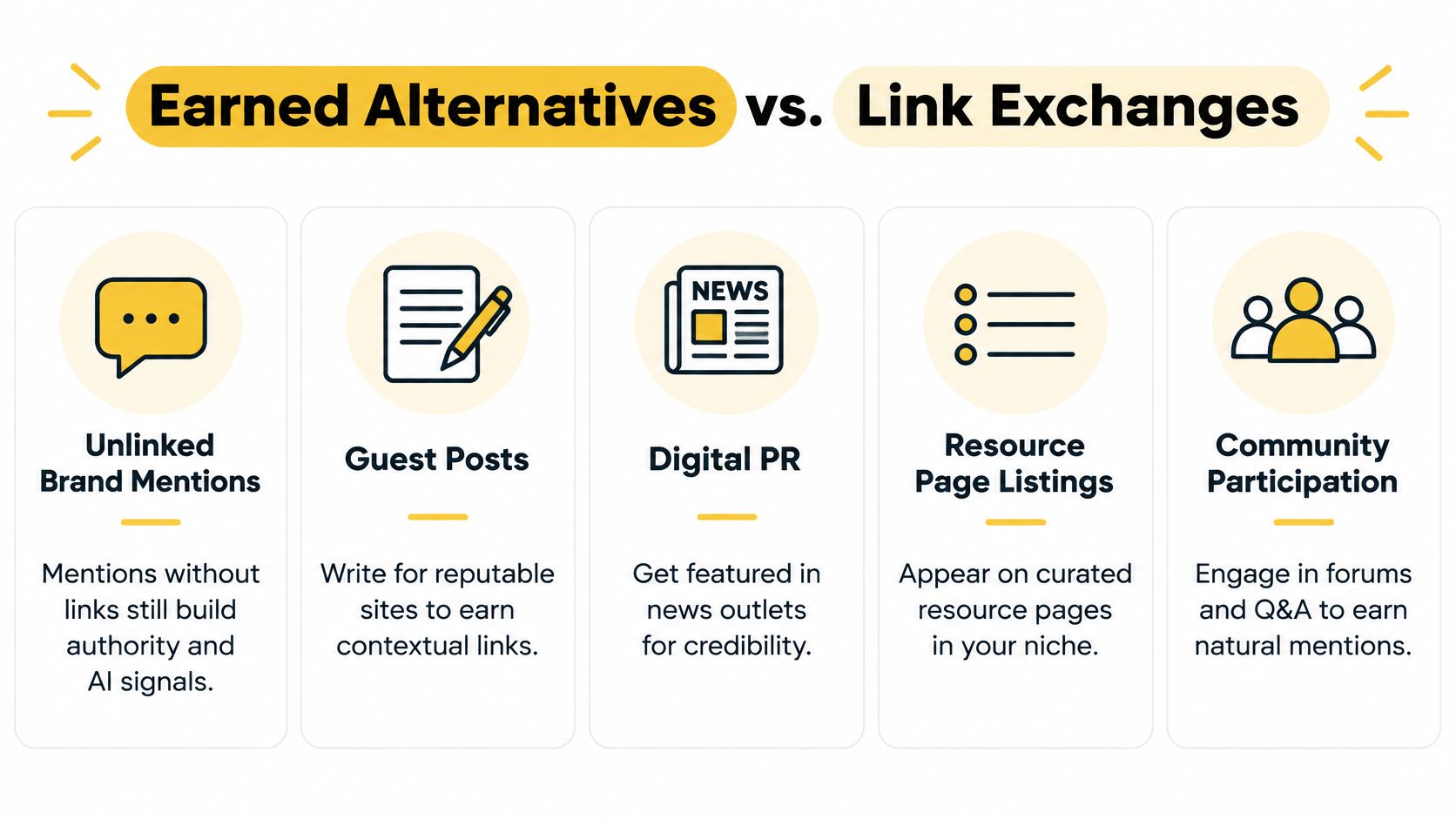
Approach | Signal it builds | Trade-off |
|---|---|---|
Original research or data others cite | Editorial citations and corroborated facts | Slow to produce, strong when the data is real |
Best-of list placement | Third-party recommendation in comparison contexts | Editorial decision the brand does not control |
Competitor comparison article | Accurate head-to-head positioning | Must be fair, or it damages credibility |
Authentic community participation | Mentions in discussions people trust | Requires disclosure and genuine value; slow to scale |
Sponsored placement | Visibility and direct referral traffic | A budget line: average US$83 per paid link in 2024, per Shno.co's off-page SEO statistics, and it must be labeled sponsored |
Original research earns citations on a mechanic that's worth understanding. A guide competes with a thousand other guides. A number nobody else has published is different, because citing it is the cheapest way for a writer to support the argument they're already making. Keep the study ungated, put each finding in the page text with its own anchor, and other publishers can link to the specific figure instead of a PDF they'd have to download. That's the difference between a lead magnet and a source.
Say a commercial HVAC contractor publishes a maintenance-cost benchmark drawn from its own anonymised service tickets. Trade publications covering facilities budgets cite the figures, then cite them again the following year when the numbers update. The contractor earned mentions that describe its data accurately, and some of those mentions will never carry a link.
Decision rule: choose the approach that produces an accurate, attributable mention a reader would find useful, and accept that the best mentions often arrive without a link.
Our approach to link building services that earn placements rather than buy them comes from this principle. We pursue a link only when it's natural and appropriate inside a discussion, and a mention counts whether or not it carries one. Our mention and citation work covers best-of lists, comparisons, communities and reviews, not only links, because those placements often influence AI recommendations even when a link is nofollow or secondary. We don't use automated tools, link networks or spam tactics to build any of it.
How Link Exchanges Affect AI Visibility and What to Measure
Answer engines such as ChatGPT, Perplexity, Gemini and Claude work differently from a ranking algorithm. They retrieve pages, compare claims across sources, and cite the ones that state facts clearly and consistently. SEO remains the foundation underneath that process, and AI search optimization focuses on how generative engines interpret, validate, summarize and cite information across multiple sources.

The numbers point away from link volume as the main lever. A reported analysis of 6.8 million AI citations found that 86% of generative-AI answers drew from brand-managed sources such as official websites, listings and reviews (eMarketer on AI search and brand data). That doesn't make reciprocity irrelevant. It reframes the question you should ask about any exchange: does this arrangement create a corroborated, accurate reference that an answer engine can lift and repeat?
A customer case study does. A standards-body reference does. An integration page that states exactly how two products connect does. A footer link between two sites that share nothing but an SEO spreadsheet does not.
Five things to measure instead of domain metrics
Accurate brand mentions, including the ones with no link.
Inclusion in answer citations for the questions your buyers ask.
Entity disambiguation, meaning an engine can tell your brand apart from a similarly named company.
Qualified referral visits, measured by engagement rather than raw sessions.
Consistency of product claims across your site, partner pages, directories and reviews.
That fifth item is where exchanges do damage. Say a SaaS brand's partner page still lists last year's plan name. Answer engines repeat the outdated name because no other source corrects it, and the partner page looks authoritative to a system comparing claims. A regional accounting firm has a version of the same problem: its service page, directory profile and review listing give three different founding years, so no single source is clearly the authoritative one. Neither problem is a link problem in the traditional sense, and neither gets fixed by buying more links. (Watch this YouTube breakdown on how entity consistency and off-site citations shape AI recommendations).
Our AI visibility work for SaaS teams treats this as an integrated system rather than a link campaign, combining authority building, entity clarity, technical readiness, citation strategy and content execution. For Remote, that meant placements in retrieval-critical sources, including high-quality best-of lists, mentions in top HR journals, and authentic engagement in authoritative Reddit threads.
Google's policy on manipulative exchanges hasn't changed because answer engines arrived. AI visibility is never a justification for artificial linking, and a reciprocal scheme that would fail the editorial test in traditional search fails it here too.
Decide Which Exchanges to Keep and Where to Start
A reciprocal link is rarely a yes-or-no call. Intent and scale decide the verdict, so turn the framework into a week of work: six steps, in this order.
Inventory every reciprocal link. Include footers, partner pages, resource lists, association profiles, integration pages and old directory submissions. Export both your outbound external links and your inbound referring domains, then match them.
Sort each one into keep, relabel or end, using the audit questions above. Many inventories keep more links than teams expect, which surprises those who assumed a cleanup meant removal.
Remove the highest-risk patterns first. Sitewide footer swaps and thin partner directories come out before anything subjective gets debated, because those two carry the least editorial justification and the most repetition.
Fix the labelling on what stays. Paid and user-generated links get the attributes that describe them, and the register gets updated so the next review starts from a current file rather than a spreadsheet from two years ago.
Replace the weak exchanges with earned alternatives. Commission a piece of original data, write a fair comparison, or show up consistently in the communities your buyers already read. This step is slower than the first four, and it is the one that keeps building value after the cleanup ends.
Set a quarterly review that reads rankings, AI citations and accurate mentions together. Generative engine optimization helps a brand become recognised, trusted and cited across traditional search and generative platforms, and after those platform insights the work runs through content, citations, authority building, technical GEO and answer engine optimization. A review that only checks positions will miss the mentions doing the corroborating.
For every link that survives, write down three things: why it exists, the label it carries and the fact it supports. That record is what separates a defensible placement from a pattern an outside reviewer has to guess at, and it is what gives an answer engine a corroborated fact worth citing.
Keep criteria, in full: keep a link only if it would exist without the agreement, it carries the correct label, and it supports a fact that readers or AI systems can verify. Everything else gets modified or cut.
The next step is the inventory. One spreadsheet, every reciprocal link, three possible verdicts, and a date on each decision. For a broader view of sequencing this work against budget, this guide to affordable search engine optimization covers where link and mention work fits relative to technical and content priorities.
We build mention and citation strategies across best-of lists, comparisons, communities and reviews, and tracks how brands appear across ChatGPT, Perplexity and Gemini. Links are pursued only where they are natural and appropriate within a discussion, and mentions may be linked or unlinked. If you are unsure which of your reciprocal links are earning their place, Verbatim Digital can review your link and mention placements alongside your visibility in AI-generated answers, starting with a free audit that shows what to keep, relabel or remove.
Recent Blogs

AI Visibility Metrics That Prove Business Value
The most repeated advice about ai visibility metrics is to add a...
View Details
AI Visibility Services: What They Cover and When to Buy
Google AI Overviews went from 7 countries in 2024 to 229 countries...
View Details
Best Enterprise Rank Tracking: 10 Platforms Compared in 2026
If "position one" now depends on the city, the device, a featured...
View Details
Search Optimization Software: 10 Tools That Drive Visibility
If your brand ranks on Google but disappears when buyers ask ChatGPT,...
View Details
AI Visibility Agency: What It Does and How to Choose One
Only about 1% of visits to Google pages containing an AI Overview...
View Details
Ditch GA4: Why It's Time to Switch to PostHog and Go High Level
Are you still running GA4 for traffic, Microsoft Clarity for heatmaps, HubSpot...
View Details
Affordable Engine Optimization Search: A 2026 Budget Plan
The cheapest SEO package is often the least affordable one you can...
View Details
AIO and GEO Explained: How to Win Visibility in AI Search
AIO refers to Google's AI Overviews feature, which places an AI-written answer...
View Details
AI Search Optimization Startups with Top Visibility Metrics
The popular advice to buy whichever platform offers the highest AI visibility...
View Details
7 Best Rated AI Visibility Generative Optimization Providers
Are you measuring where your pages rank, or whether buyers hear your...
View Details