October 29, 2026
Affordable Engine Optimization Search: A 2026 Budget Plan
The cheapest SEO package is often the least affordable one you can buy. It spreads a small budget across blog posts, minor fixes, and a handful of links, proves nothing about revenue, and leaves you t...
Table of content
October 29, 2026
The cheapest SEO package is often the least affordable one you can buy. It spreads a small budget across blog posts, minor fixes, and a handful of links, proves nothing about revenue, and leaves you to pay again to undo or replace the work. Affordable engine optimization search only works when you treat it as an allocation problem. You fund one bottleneck at a time, set a stopping rule before you start, and move money only when pilot pages beat matched control pages.
What Each Monthly Budget Buys in Search Optimization
Google is the rational starting point because StatCounter reported Google held about 89.94% of global search-engine usage in September 2026, a concentration described in the Omnibound roundup of Google search statistics. That doesn't make SEO free, because content production, technical upkeep, analytics, digital PR, and expertise all carry cost, but it means you don't need to buy visibility across dozens of equally influential platforms.
Small firms feel that trade-off hardest. The LocaliQ small business marketing trends report notes businesses with 10 or fewer employees were 31% more likely to have marketing budgets below $500 per month and 31% more likely to have no full-time marketing employee. It also shows 30.5% of surveyed providers reported monthly pricing of $1,000 to $1,500, while 36.3% expected annual SEO spending below $10,000, so a single market rate doesn't exist.
Budget Tiers, Coverage and the Evidence for the Next Dollar
Monthly budget | What it realistically covers | What to skip | Evidence for the next dollar |
|---|---|---|---|
$500 | Baseline audit, indexing and sitemap fixes, two to four rewritten pages | Link buying, bulk content, paid AI tracking subscriptions | Pilot pages gain non-brand impressions over 8 weeks |
$1,500 | Ongoing technical fixes, four to six intent-mapped pages, internal linking, monthly pilot reporting | Sitewide schema rollout, enterprise migrations | Pilot cohort shows CTR or qualified clicks above matched control pages |
$5,000 | Full crawl and content program, tier-1 PR or citation campaigns, measurement dashboard | Overbuying schema before any pilot results | Share of voice in AI answers and qualified leads rise together |
The table is a funding sequence, not a shopping list. I'd start at the tier that fixes your proven blocker and nothing more.
Stopping rule: A tier earns more money when pilot pages show non-brand impressions or qualified clicks rising against matched control pages. A tier with no movement after two full cycles loses its funding.
Say a plumbing company has $500 a month. It doesn't need twelve blog posts. It needs someone to clear Search Console indexing errors, fix its Google Business Profile details, and rewrite three service pages for emergency repair, water heaters, and drain clearing so each page answers price range, response time, and service area in plain language. That work fits the budget because competition is local and the buying intent is narrow.
A SaaS firm at $5,000 faces a different problem. Its head terms are contested by funded competitors, so rewrites alone won't move it. I'd split that budget between documentation that answers setup and integration questions and digital PR that earns third-party references on sites buyers already trust. The documentation gives search and AI systems something accurate to cite. The PR gives them a reason to trust it.
Two Inputs Set Your Tier
Competition for head terms: A local service business in a low-competition market will usually stay in the $500 or $1,500 tier, while a SaaS brand chasing contested category terms may need $5,000 to earn credible references.
Current search dependence: If search already drives a meaningful share of pipeline, you have baseline data to run pilots against. If it drives almost nothing, spend first on indexability and conversion pages before you fund content volume.
Pick the tier from those two inputs, not from a provider's package name. The next dollar should always have to justify itself against evidence from the last one.
A 90-Day Sequence for Limited Budgets
Order protects a small budget because Google makes significant broad changes to its ranking systems several times each year, a pattern traced in the SEO Handbook timeline of Google algorithm updates. That history runs from Panda in February 2011 against low-quality content and Penguin in April 2012 against link spam and keyword stuffing through BERT in 2019 and the Helpful Content Update in 2022. Tactics built on manipulation keep becoming targets, so a durable foundation outlasts any shortcut you could buy cheaply.
The visual below compresses the same logic into three phases for a quick planning check.
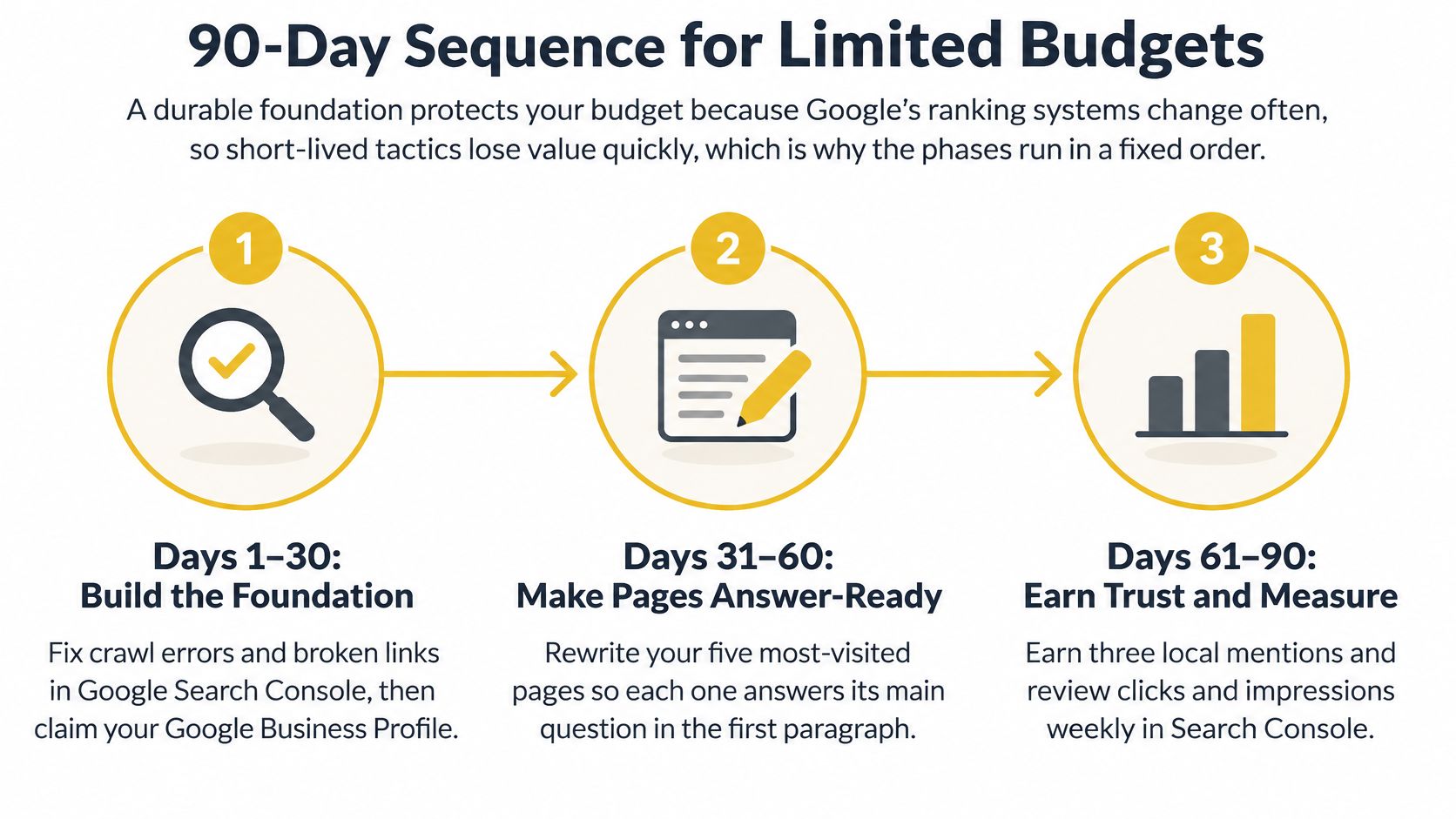
The Four Phases
Weeks 1 to 2, record the baseline: Export several months of Google Search Console data, select five to ten stable pages without strong seasonality, and check for spam-policy exposure such as hidden text, scaled thin pages, and purchased links. You can't judge a pilot without this record.
Weeks 3 to 6, clear blockers first: Fix indexing errors, duplicate URLs, broken internal links, and pages Google can't render before you write anything new. New content on a site Google struggles to crawl is money spent in the wrong order.
Weeks 7 to 10, launch a small pilot cohort: Rewrite or create one page per distinct search intent. Keep templates stable, log every change with a date, and resist editing control pages during the test.
Weeks 11 to 13, decide: Compare pilot pages against matched controls on clicks, impressions, CTR, and average position. Expand what moved, hold what's inconclusive for one more cycle, and stop what didn't move at all.
Ninety days gives you a first decision, not a finished result. Rankings on competitive terms take longer, and a single core update can muddy any short window. What you get in 13 weeks is evidence about which page types respond to your effort and which ones absorb budget without returning anything.
Say a 12-person accounting firm runs this sequence. Its blog pilot shows no change in service-page clicks after the test window, while two service pages already sitting on page two gain impressions after rewrites. The rational move isn't more blog posts. It's shifting next quarter's money to those service pages and the internal links pointing to them.
A page type with no movement after two full cycles should lose budget, even if it feels strategically important. Sentiment isn't a measurement.
That discipline is what makes a limited budget survivable. You're not trying to do everything slowly. You're trying to find the one or two workstreams that produce qualified demand for your market, then fund those properly.
Low-Cost Technical Fixes Worth Doing First
Technical work comes first because it's mostly labor, not media spend, and because every later investment depends on Google being able to find and index your pages. Start with the checklist below before you commission content.
Low-Cost Technical Fixes, Effort and Verification
Fix | Typical effort | How to verify | Main risk |
|---|---|---|---|
Confirm key pages are indexable | 1 to 3 hours | URL Inspection in Search Console | Noindex tags left on templates |
Generate and submit an XML sitemap | 1 to 2 hours on most CMS platforms | Sitemaps report and coverage status | Listing thin or parameter URLs |
Consolidate duplicate filter and parameter URLs | 4 to 10 hours | Crawl diagnostics and index coverage | Removing URLs that already earn traffic |
Add valid JSON-LD to 10 to 20 pilot pages | 3 to 6 hours | Rich Results Test and enhancement reports | Marking up content not visible on the page |
Strengthen internal links to money pages | 2 to 4 hours | Crawl tool click-depth report | Linking every page sitewide |
Remove or merge thin autogenerated pages | 4 to 8 hours for audit and redirects | Index coverage and traffic before removal | Deleting pages that rank for real queries |
Audit backlinks for paid link schemes | 2 to 5 hours | Exported link report | Disavowing legitimate links |
Effort figures are planning estimates that vary with site size and CMS quality. A clean WordPress site sits at the low end. A custom e-commerce build with faceted navigation won't.
The sitemap sequence matters. Confirm important URLs are indexable, then generate and submit an accurate sitemap, then monitor coverage. Google's get started documentation for Search describes XML sitemaps as a way to tell Google which pages are important and help discovery of images and video, while noting Google prioritizes crawling sitemap-listed pages. A sitemap doesn't guarantee indexing or rankings, so it supports internal linking and crawl-error fixes rather than replacing them.
Say an e-commerce retailer lists every filter combination in its sitemap. I'd exclude duplicate filter parameter URLs, consolidate them to the category pages that earn traffic, and keep product and editorial URLs that answer real queries. A SaaS company should do the opposite with its best assets and prioritize documentation and integration pages, because those are the pages buyers and answer engines need during evaluation.
Structured Data and the Spam Check
Add valid JSON-LD only where markup accurately describes visible content, pilot it on 10 to 20 pages, and verify through URL Inspection and enhancement reports. Google's introduction to structured data recommends a before-and-after test on stable, sufficiently trafficked pages because eligibility for rich results doesn't guarantee display. Judge the pilot on incremental clicks and CTR against your baseline, not on whether a rich result appeared once.
Finish with an inventory of autogenerated pages, duplicates, and backlink sources. Remove or consolidate anything built to manipulate rankings, including keyword stuffing, hidden text, and bulk near-duplicate pages. That audit costs hours. Recovering from a demotion costs quarters.
Getting Cited in AI Answers on a Small Budget
Ranking well no longer guarantees a visit. A Pew Research Center analysis of 68,879 Google searches from 900 U.S. adults in March 2025 found an AI summary appeared in 18% of searches. Users clicked a traditional result in 8% of visits when a summary appeared, compared with 15% when no summary appeared, and only 1% clicked a source link within the AI summary.
The image below shows the practical situation you're optimizing for, a buyer reading results on a laptop and deciding without necessarily visiting your site.
For informational queries, being named or recommended can matter more than the click you didn't get. For high-intent queries, a missing or incorrect recommendation is lost demand, because the buyer shortlists from the answer itself. Systems such as ChatGPT, Perplexity, Gemini, and Claude draw on crawlable pages, consistent entity facts, and third-party mentions, so the cheapest work is making your facts easy to extract and corroborate. Our practical guide to AI search optimization covers the broader method behind the steps below.
Five Moves a Small Team Can Finish This Month
Write answer-first passages: Put a 40 to 60 word direct answer under each question heading, then support it with detail, pricing factors, and proof.
Make company facts identical everywhere: Use the same name, category, location, and service descriptions across Google Business Profile, LinkedIn, industry directories, and funding databases.
Earn third-party proof: Pursue reviews and expert quotes on comparison and review sites buyers consult, not generic directories.
Show up in communities openly: Join relevant Reddit communities, disclose your affiliation, and answer questions. Seeded or fake posts become a liability when they're discovered.
Treat Wikipedia cautiously: Pursue it only where independent coverage establishes notability, and don't edit your own article directly.
The short video below is useful background on how answer-ready pages are structured in practice.
Say a SaaS team turns its ten most-asked setup questions into answer-first documentation passages, each with exact steps and error messages. It then logs monthly which assistants name its product for those questions. That's a measurable citation program built from support tickets it already owns.
Don't try to game the answer. Google's spam policies documentation explicitly covers attempts to manipulate generative-AI responses, and policy violations can lead to demotion or removal from results. Cheap manipulation is the fastest way to make a small budget worthless.
Measuring Results Without Overrating Traffic
The evidence on clicks conflicts, so don't build your budget case on one traffic number. The Mashable summary of the Pew Research Center study reports users clicked an external result on 8% of visits when an AI Overview appeared, compared with 15% without one, with only 1% clicking a cited link inside the summary. Google reports a more favorable view, saying overall organic click volume remained relatively stable year over year and average click quality increased.
Both can be true for different query mixes. That's why affordable measurement tracks a small set of signals instead of chasing a universal benchmark. A structured AI visibility audit guide can help you set the baseline for the AI-specific rows.
Measurement Signals, Sources and Cost
Metric | Where to get it | What it tells you | Cost to track |
|---|---|---|---|
Non-brand impressions and query count | Search Console | Visibility for new queries | Free |
CTR on pilot pages versus matched controls | Search Console | Whether snippets earn clicks | Free |
Branded search trend | Search Console monthly trend | Demand created by PR or content | Free |
Share of voice in AI answers versus named competitors | Tracking tool | Relative visibility | Manual log free, tool subscription moderate |
Qualified organic conversions | GA4 or CRM | Revenue relevance of organic traffic | Free to moderate |
Assisted revenue | Analytics attribution model | Influence beyond the last click | Free in GA4, moderate with CRM integration |
Track AI citation frequency by logging 20 to 30 buyer prompts monthly, by hand at first. Record whether you're named, whether the facts are right, and which two or three competitors appear instead. You don't need a platform subscription to learn that you're absent from your own category's shortlist.
Read every metric through the intent split. Zero-click visibility on informational queries may build trust that shows up later as branded search. A missing recommendation on a high-intent comparison query costs leads now.
Say a retailer sees organic sessions fall on guide pages while qualified product-page conversions hold steady. I'd keep funding product pages, cut guide production, and rewrite the surviving guides as answer-first pages built for citation rather than traffic. The sessions metric alone would have pushed the wrong decision.
Reporting rule: Put leading indicators next to conversions in every report. Rankings alone justify nothing.
Choose Between Doing It Yourself and Hiring Help
Low-cost help exists, but price tells you little about scope. A survey summary of 260 SEO agencies by SE Ranking and Duda found 64% of SEO agencies surveyed charged less than $1,000 per month in 2025. At that level you're often buying a generic audit and templated tasks, so judge the work plan, not the fee.
The image below captures the comparison you're really making, your own task list against a proposal with a monthly price attached.

In-House and Outsourced Options Compared
Option | Typical monthly spend | What you control | Best fit |
|---|---|---|---|
In-house owner with software tools | Staff hours plus software under $500 | Priorities, pace, and page copy | Narrow service area with time available |
Freelance writer and technical contractor | $500 to $1,500 scoped by page and fix | Content quality, limited strategy | Sites with a working technical base |
SEO agency retainer | Many agencies charge under $1,000, scope sets the real price | Shared strategy and reporting | Teams needing audits and a content plan |
Specialist AI visibility platform with services | $1,500 to $5,000 for platform plus execution | Measurement and digital PR execution | SaaS and e-commerce brands losing visibility to AI Overviews |
Keep work in-house when one person has real time and your service area is narrow. Hire when a pilot shows promise but execution is the bottleneck, especially for technical audits and digital PR. Providers offering SEO services, including Verbatim Digital with its AI visibility platform and hands-on work across technical SEO, digital PR, and citation building, should all face the same checks.
Ask any vendor for five things before you sign. You want a baseline report, a dated change log, pilot results against control pages, written stop criteria, and a list of tactics the vendor won't use. Also ask for pricing split by strategy, content, technical work, and reporting so quotes compare on equal scope.
Then make the decision in order. Pick one budget tier, run the 90-day sequence, and decide on outside help at week 13 using your measurement signals. Cheap SEO is slow and never free, but sequenced spending keeps every dollar accountable.
If your pilot data shows promise but your team can't execute technical fixes, citation building, and AI visibility measurement at once, Verbatim Digital can run that sequence with you, from SEO and content strategy to tracking how your brand is cited across ChatGPT, Perplexity, and Gemini. Start with a baseline audit, see exactly where you're visible and where you're missing, and fund the next step only when the evidence supports it.
Recent Blogs

AIO and GEO Explained: How to Win Visibility in AI Search
AIO refers to Google's AI Overviews feature, which places an AI-written answer...
View Details
AI Search Optimization Startups with Top Visibility Metrics
The popular advice to buy whichever platform offers the highest AI visibility...
View Details
7 Best Rated AI Visibility Generative Optimization Providers
Are you measuring where your pages rank, or whether buyers hear your...
View Details
10 Best Solutions for AI Visibility in 2026
When a buyer asks ChatGPT, Perplexity, or Google Gemini for a recommendation,...
View Details
AI Search Optimization Agency: A Practical Guide
Your organic traffic looks stable, yet the pipeline report tells a different...
View Details
Digital Marketing for B2B: End-to-End Playbook
A buying committee visits your website, reads a comparison page, asks ChatGPT...
View Details
Best Answer Engine Optimization Tools: 10 Picks
AEO tools don't solve one universal visibility problem. A platform that measures...
View Details
Top Answer Engine Optimization Software for 2026
AI Overviews appeared in 6.49% of queries in January 2025 and 13.14%...
View Details
AI Search Optimization: A Practical Guide for 2026
A mid-market SaaS company can keep its branded search demand stable while...
View Details
AI SEO Software: What It Is and How to Choose One
Most advice about AI SEO software is wrong. It treats the category...
View Details